Modern, contactless, and individually tailored supportive pain treatment
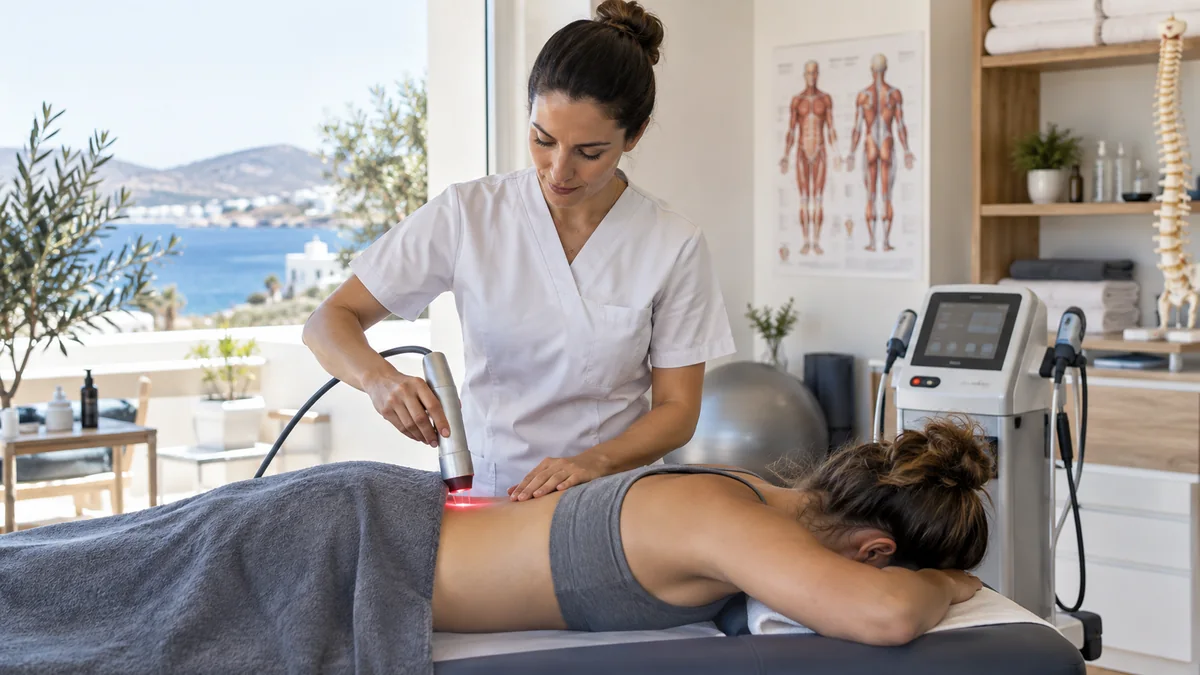
In our Bodrum clinic, we use 980 nm and, in selected cases, 1470 nm diode laser technologies for myofascial pain, tendon-related pain, and certain periarticular pains, directed toward the target tissue identified through examination. The goal is not only to reduce the pain score, but to support movement, load tolerance, and participation in rehabilitation.
Quick answer
980 nm is our primary wavelength, with broader clinical experience and literature support in musculoskeletal pain. 1470 nm is a wavelength with higher water absorption, more superficial penetration, and a pronounced thermal effect; for this reason, it is not used routinely in every patient, but is selected based on the anatomical target and tissue depth. In the appropriate patient, laser therapy is planned not as a replacement for exercise, rehabilitation, manual therapy, or other pain treatments, but as a complementary modality.
Which types of pain can it be used for?
Muscles and trigger points
- Upper trapezius and cervical myofascial pain
- Low back and thoracic paraspinal pain
- TMJ-related myofascial pain originating from the masseter and temporalis
Tendon and soft tissue
- Rotator cuff tendinopathy and subacromial pain
- Lateral and medial epicondylitis
- De Quervain’s and selected wrist tendinopathies
- Patellar and Achilles tendinopathy
- Plantar fasciitis
Knee and surrounding area
- Periarticular pain in knee osteoarthritis
- Patellofemoral pain
- Pes anserine region pain
Selected other conditions
- Trochanteric pain and gluteal tendinopathy
- An appropriate low-thermal approach in postoperative or periwound pain
- Only superficial/periarticular targets in deep hip or SI joint pain
The difference between 980 nm and 1470 nm
| Feature | 980 nm | 1470 nm |
|---|---|---|
| Clinical role | Primary wavelength in musculoskeletal pain | Adjunctive wavelength for selected superficial targets |
| Tissue approach | Suitable for deeper muscle and periarticular targets | Higher water absorption; more superficial and pronounced thermal effect |
| Evidence base | Stronger myofascial pain and HILT literature | Direct clinical data in musculoskeletal pain is more limited |
| Planning | Prioritized in most appropriate cases | Selective based on anatomical target and safety assessment |
Our approach in our Bodrum clinic
Not every pain is suitable for laser. First, we evaluate the source, depth, and mechanism of the pain. If muscle, tendon, or periarticular tissues can be targeted, we combine laser therapy, as needed, with personalized exercise, load management, manual approaches, injection/interventional options, or other treatments. In structures that a superficial probe cannot directly reach, such as the deep hip joint, SI joint, or nerve roots, we do not present laser therapy as a procedure that “treats the target tissue.”
What is felt during the session?
Depending on the application, there may be a mild sensation of warmth. The energy level is adjusted by taking into account the vascular structure of the area, subcutaneous adipose tissue, target depth, and the patient’s sensory feedback. The goal is not to generate uncontrolled heat, but to achieve a safe biological and analgesic response in the target tissue.
How many sessions are required?
There is no single standard number of sessions. The plan for an acute and superficial tendon problem is not the same as that for long-standing myofascial pain. A short course of treatment can be planned following the initial evaluation; response is monitored through pain, range of motion, tenderness, load tolerance, and daily function.
In whom should caution be exercised?
- Over areas of active malignancy or undiagnosed masses
- In and around the eyes without appropriate protection
- Over the uterine area during pregnancy
- In areas with active bleeding, marked sensory loss, or where thermal feedback is unreliable
- In conditions involving photosensitizing drugs or diseases, without prior clinical evaluation
Definitive suitability is determined following physical examination and medical history.
Scientific basis
For 980 nm photobiomodulation, a randomized study dated 2025 reported improvement in pain and mandibular function in myofascial TMD pain. Regarding HILT, systematic reviews from the 2023–2026 period report favorable outcomes in lateral epicondylitis, subacromial pain, knee osteoarthritis, and patellofemoral pain. In patellofemoral pain, certainty of evidence is low and exercise accompanied the treatment in all studies; for this reason, we position laser as part of multimodal therapy. For 1470 nm, direct clinical data in musculoskeletal pain are more limited; the decision to use it is made according to the tissue characteristics of the wavelength and the target anatomy.
Frequently asked questions
Does laser therapy completely eliminate pain?
The outcome varies depending on the cause of the pain. The most accurate use of laser is achieved when the pain source can be targeted and, if necessary, applied in conjunction with exercise/rehabilitation.
Can a herniated disc or nerve root be treated directly with laser?
A deep disc or nerve root is not directly targeted with a superficial probe. In appropriate patients, supportive use may be considered for paraspinal muscle spasm, myofascial component, or accompanying soft tissue pain.
Does laser replace exercise?
For most musculoskeletal problems, no. Particularly in tendon, knee, and shoulder problems, load management and exercise are fundamental components of treatment for lasting functional gain.
Related laser pain treatment pages
- Myofascial pain and trigger point laser treatment
- Laser in shoulder and rotator cuff pain
- Laser in elbow, wrist, and superficial tendinopathies
- Laser in knee osteoarthritis and patellofemoral pain
- Laser in foot, heel, and Achilles pain
- Laser in low back pain
- Laser in neck pain
- Laser in sciatica and lumbar disc herniation-related nerve pain
- Post-shingles nerve pain / postherpetic neuralgia
Evaluation for laser pain treatment in Bodrum
We plan whether pain is an appropriate target for laser, which wavelength will be selected, and how the treatment will be combined with exercise, rehabilitation, or other pain modalities following an examination.
References
- Randomized controlled trial: 980 nm vs 635 nm diode photobiomodulation in myofascial pain, 2025. PMID: 41039333.
- Systematic review and meta-analysis: HILT in subacromial impingement syndrome, 2024. PMID: 39317844.
- Systematic review and meta-analysis: HILT in lateral epicondylitis, 2023. PMID: 35512124.
- Systematic review and network meta-analysis: HILT + exercise in knee osteoarthritis, 2024. PMID: 39193110.
- Systematic review and meta-analysis: HILT in patellofemoral pain, 2026. PMID: 42286680.
To evaluate the role of laser applications in pain management alongside other options, you can review the Pain Management main guide.