What is Chronic and Mechanical Low Back Pain?
Chronic and Mechanical Low Back Pain requires the accurate identification of the structure causing the pain and the underlying pain mechanism. Pain felt in the same area can originate from muscle, tendon, joint, fascia, nerve, or, more rarely, other systems. For this reason, rather than planning laser therapy based solely on the location of the pain, medical history, physical examination, movement, strength, neurological findings, and, when necessary, imaging should be evaluated together.
How can laser help in this condition?
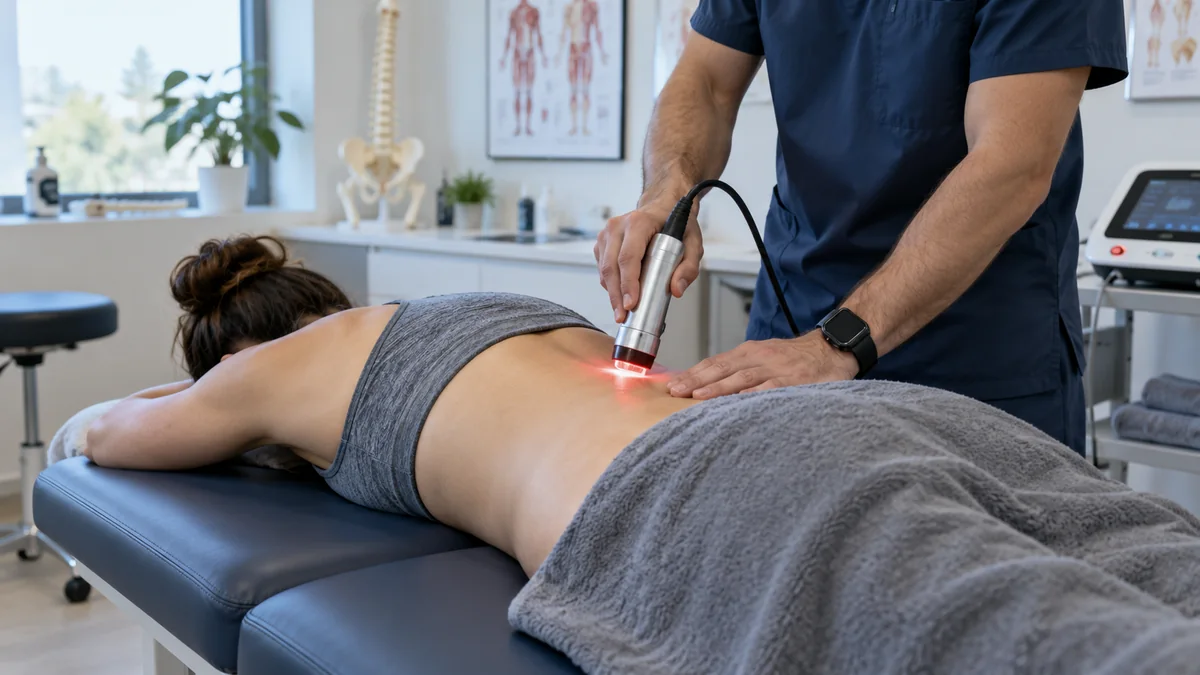
In studies on high-intensity laser therapy (HILT) and photobiomodulation, analgesic effects, modulation of the inflammatory response, and effects on microcirculation and tissue metabolism have been investigated. The clinical goal is to reduce pain to support movement, exercise tolerance, and daily function. It should not be stated that laser eliminates the structural cause of the disease or “regenerates” tissue in every case.
The role of 980 nm
It is considered the primary wavelength for superficial and intermediate-depth muscle-tendon/periarticular targets; the majority of the clinical HILT literature derives from 980 nm or similar NIR wavelengths.
The role of 1470 nm
Because 1470 nm is more superficial and thermal in character, it is not recommended as a routine primary wavelength in this condition; it is evaluated selectively only if there is an accompanying very superficial target.
What does the scientific evidence say?
Level of evidence: A — Strong direct systematic review/meta-analysis support.
There are direct clinical data at the systematic review or meta-analysis level regarding HILT/laser therapy for Chronic and Mechanical Low Back Pain. Although studies generally report pain reduction and improvement in certain functional measures, there is heterogeneity across devices, wavelengths, energy doses, and accompanying exercise programs. Therefore, the results should not be interpreted as a ‘definite effect in every patient.’
While positive outcomes regarding pain and function are reported in the general HILT literature, a 2024 umbrella review emphasized that the methodological quality of systematic reviews is mostly low or critically low. For this reason, statements such as “definitive cure,” “guaranteed results,” or “the most effective method” should not be used in web text.
In whom can it be considered?
- In individuals in whom a painful target tissue or region can be identified upon examination
- If movement or exercise is difficult due to pain, in order to facilitate rehabilitation
- When a noninvasive option to assist the conservative treatment plan is sought
- When active infection, acute severe trauma, or urgent neurological conditions are excluded upon physician evaluation
Is laser sufficient on its own?
In most cases, no. Graded activity, trunk endurance, hip strength, preservation of daily movement, and ergonomic adjustments when necessary are parts of the core plan. If laser is applied, success should not be monitored solely by post-session pain scores, but through measurable goals such as range of motion, strength, walking/sports capacity, sleep, and daily function.
Our approach in our Bodrum clinic
Our approach in our Bodrum clinic is to first clarify the diagnosis of chronic and mechanical low back pain and the true source of the pain, and then evaluate the use of 980 nm, or 1470 nm in selected superficial areas, depending on the depth and safety of the target tissue. We treat laser application not as an isolated device-oriented procedure, but as part of a personalized plan combined with movement, exercise, load management, medical treatment, and, when necessary, interventional pain procedures.
When is a different or urgent evaluation required first?
Changes in bowel or bladder control, numbness in the saddle area, newly developing significant loss of strength, fever, severe trauma, or unexplained weight loss. In the presence of these findings, the underlying cause must be clarified first; laser application should not cause a delay in diagnostic evaluation.
Frequently asked questions
Does Chronic and Mechanical Low Back Pain resolve completely with laser?
Laser can support pain and movement/functional tolerance in some patients; however, the outcome is determined by the cause of the disease, its duration, tissue damage, loading, and accompanying treatments. On its own, it does not guarantee a definitive or permanent solution.
Is 980 nm or 1470 nm preferred?
It is evaluated as the primary wavelength for superficial and mid-depth muscle-tendon/periarticular targets; the majority of clinical HILT literature derives from 980 nm or similar NIR wavelengths. Because 1470 nm has a more superficial and thermal character, it is not recommended as a routine primary wavelength in this situation; it is evaluated selectively only if there is an accompanying very superficial target.
How many sessions are required?
A fixed number of sessions should not be applied to all patients. It is individualized by the physician according to the diagnosis, target tissue, acute versus chronic phase, response to the initial sessions, and accompanying exercise plan.
Does laser replace exercise or other treatments?
For most musculoskeletal and neuropathic pain conditions, no. Laser is an adjunctive option evaluated in conjunction with exercise, load management, medical therapy, physical therapy, or interventional procedures when necessary.
References
- High-intensity laser therapy in low back pain management: a
systematic review with meta-analysis. 2023. PMID: 37493840. https://pubmed.ncbi.nlm.nih.gov/37493840/ - Effect of diode laser in the treatment of patients with nonspecific
chronic low back pain: a randomized controlled trial. 2014. PMID:
25141218. https://pubmed.ncbi.nlm.nih.gov/25141218/ - Quality appraisal of systematic reviews on high-intensity laser
therapy for musculoskeletal pain management: an umbrella review. 2024.
PMID: 39652213. https://pubmed.ncbi.nlm.nih.gov/39652213/ - Wavelength/physics note: Comparison between contact diode laser with
980 nm and 1470 nm wavelengths for posterior laryngofissure in pigs.
2024. Scientific Reports. https://www.nature.com/articles/s41598-024-62333-3
Disclaimer
This content is for general health information purposes; it is not a personal diagnostic or treatment recommendation. Appropriateness must be determined by a physician based on examination, diagnosis, medications used, skin characteristics, circulatory/sensory status, and the anatomy of the target region.