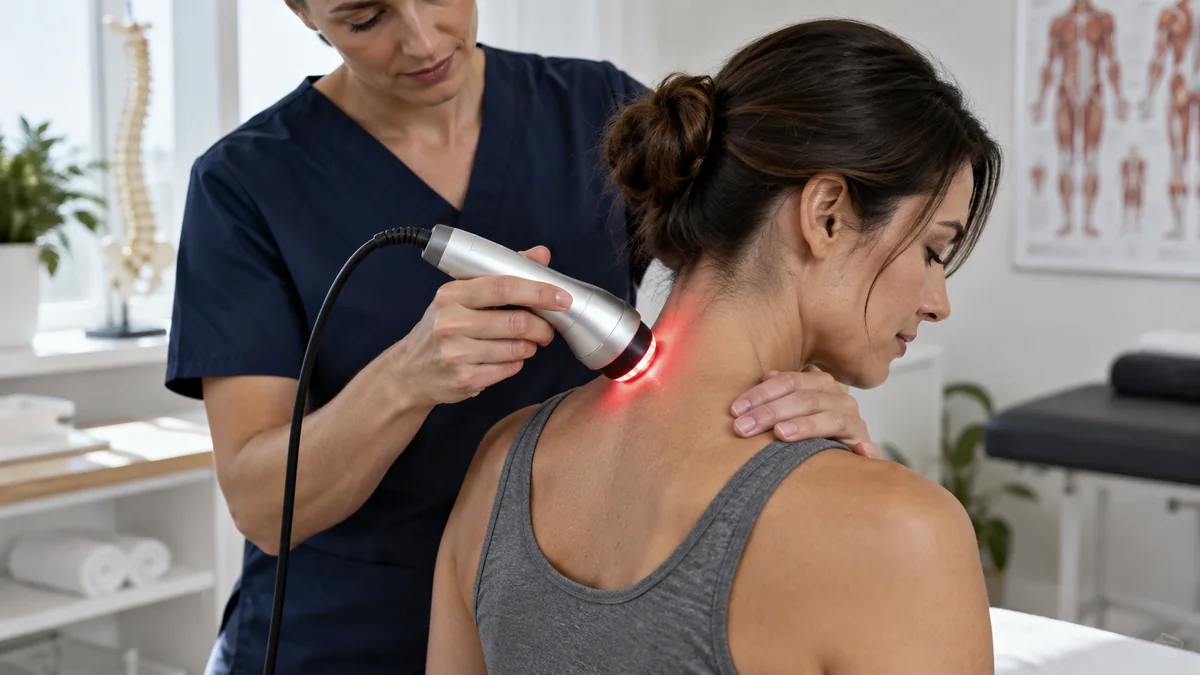
What are mechanical neck pain and stiffness?
Neck pain can originate from muscles, fascia, facet joints, discs, tendons, or neural structures. Prolonged desk work, repetitive loading, sleeping posture, cervical range of motion limitation, and impaired scapular control may accompany the condition. For this reason, rather than planning laser therapy based solely on the location of the pain, medical history, physical examination, range of motion, strength, and neurological findings should be evaluated together.
How can laser help?
In high-intensity laser therapy (HILT) and photobiomodulation studies, analgesic effects, modulation of the local inflammatory response, and effects on microcirculation and tissue metabolism have been investigated. The clinical goal is to reduce pain to support neck movement, daily activities, and exercise tolerance. It should not be claimed that laser eliminates the structural cause in the disc or joint in every case.
The role of 980 nm
It can be considered the primary wavelength for superficial and intermediate-depth muscle-tendon/periarticular targets. A significant portion of the clinical HILT literature derives from 980 nm or adjacent NIR wavelengths.
The role of 1470 nm
1470 nm is absorbed more strongly by water and concentrates energy more superficially. Therefore, in mechanical neck pain, it should not be considered a routine primary wavelength, but rather a selective adjunct wavelength for superficial muscle-fascia targets, with careful monitoring of skin temperature.
What does the scientific evidence say?
Level of evidence: A — strong direct systematic review/meta-analysis support. Systematic reviews and clinical studies on HILT in neck pain have reported improvements in pain and certain functional measures. Nevertheless, heterogeneity exists across devices, energy doses, treatment frequencies, and accompanying exercise programs; the results do not guarantee the same effect in every patient.
Is laser sufficient on its own?
In most cases, no. Cervical range of motion, deep neck flexors, scapular control, desk-related loading, and sleeping posture are addressed together. Success should be monitored not merely by post-session pain scores, but through measurable goals such as range of motion, daily function, sleep, and exercise tolerance.
If neck pain is due to dystonia
Mechanical neck pain and cervical dystonia are distinct clinical entities. If pain is associated with involuntary neck contractions, abnormal head posture, or dystonic movements, a separate evaluation regarding botulinum toxin in cervical dystonia can be performed.
Our approach at our Bodrum clinic
Our approach at our Bodrum clinic is to first clarify the origin of mechanical neck pain, and then consider the use of 980 nm, or 1470 nm in selected superficial areas, depending on the depth of the target tissue. We approach laser application as part of a personalized plan combined with movement, exercise, load management, medical therapy, and, when necessary, interventional pain procedures.
When is a different evaluation required first?
If there is severe post-traumatic pain, progressive weakness in the arms or legs, gait impairment, fever, or new sphincter dysfunction, the priority is diagnostic evaluation.
Frequently asked questions
Does neck stiffness resolve with laser?
In some neck pain originating from muscle and soft tissue, laser may support pain and movement tolerance; however, the cause must be accurately identified.
980 nm or 1470 nm?
For most mechanical neck pain, 980 nm is the more rational primary option. 1470 nm is considered only for selected superficial targets due to its more superficial thermal effect.
How many sessions are required?
There is no fixed number. It is individualized based on diagnosis, chronicity, target tissue, and the response to the initial sessions.
References
Disclaimer
This content is for general health information purposes. Suitability is determined by the physician based on examination, diagnosis, skin characteristics, circulatory/sensory status, and target anatomy.