What are myofascial pain and trigger points?
In myofascial pain syndrome, tender bands and trigger points can form within the muscle. Compression can cause local pain or pain referred to another area. The neck, trapezius, periscapular area, lower back, hips, and masticatory muscles are frequently affected areas.
How can laser help?
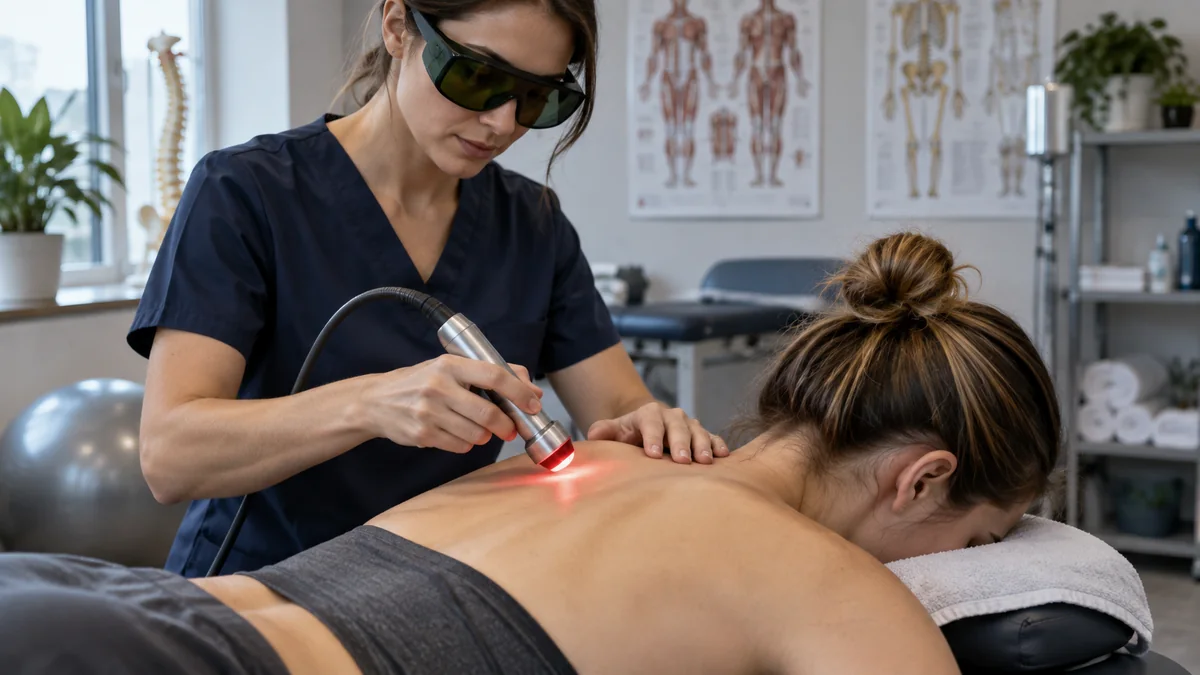
In photobiomodulation and HILT studies, analgesia, local circulation, modulation of the inflammatory response, and reduction of muscle tension have been investigated. The clinical goal is not to physically eliminate the trigger point, but to increase movement and exercise tolerance by reducing pain.
The role of 980 nm
980 nm can be considered the primary wavelength in this device for superficial and medium-depth muscle targets. In a 2025 randomized study, 980 nm demonstrated better outcomes compared to 635 nm in terms of pain reduction and mandibular function in myofascial pain; because the study had a small sample size and lacked a placebo, results should be interpreted with caution.
The role of 1470 nm
Because 1470 nm is more strongly absorbed by water, it has a more superficial and thermal character. It can be considered selectively for very superficial tender bands; however, there is no direct clinical evidence of efficacy for 1470 nm in myofascial pain.
What does the scientific evidence say?
Level of evidence: A-. A 2024 umbrella review identified myofascial pain as one of the musculoskeletal conditions where the most pronounced analgesic effect was reported with HILT, while also emphasizing that the methodological quality of systematic reviews was variable. A 2025 RCT provides positive results directly for 980 nm.
Who can be evaluated for this?
- In those with prominent trigger points or tender muscle bands upon examination
- In those with decreased movement or exercise tolerance due to pain
- In myofascial pain of the neck, trapezius, periscapular region, lower back, or gluteal area
- When acute severe trauma, infection, or neurological emergencies have been ruled out
Our approach at our Bodrum clinic
Our approach at our Bodrum clinic is to evaluate together whether the pain is muscle-derived, any accompanying joint, tendon, or nerve problems, and daily loading. If laser is to be applied, 980 nm is considered the primary option in most cases, while 1470 nm is addressed as a selective adjunctive wavelength only for very superficial targets. In addition to pain scores, outcomes are monitored through movement, strength, sleep, and daily function.
When is a different evaluation needed first?
In cases of newly developing significant weakness, fever, severe trauma, unexplained pain that progressively worsens at night, or signs of systemic disease, the underlying cause must be investigated first.
Frequently asked questions
Do muscle knots resolve with laser?
Laser may reduce pain in some patients; however, if the loading, posture, sleep, stress, or movement issues leading to the development of muscle knots are not corrected, complaints may recur.
980 nm or 1470 nm?
In this indication, clinical evidence is more direct in favor of 980 nm. There is no direct evidence of efficacy for 1470 nm, and more superficial thermal use is considered.
Is exercise necessary?
In most patients, yes. Laser is more rational as an adjunctive modality that facilitates the movement and strengthening program.
References
- PMID 41039333 — 980 nm versus 635 nm diode laser for myofascial pain, randomized trial.
- PMID 39652213 — High-intensity laser therapy for musculoskeletal pain, umbrella review.
Disclaimer
This content is for general health information; it is not a personal diagnosis or treatment recommendation. Suitability is determined through a physician examination.