Who is it evaluated for?
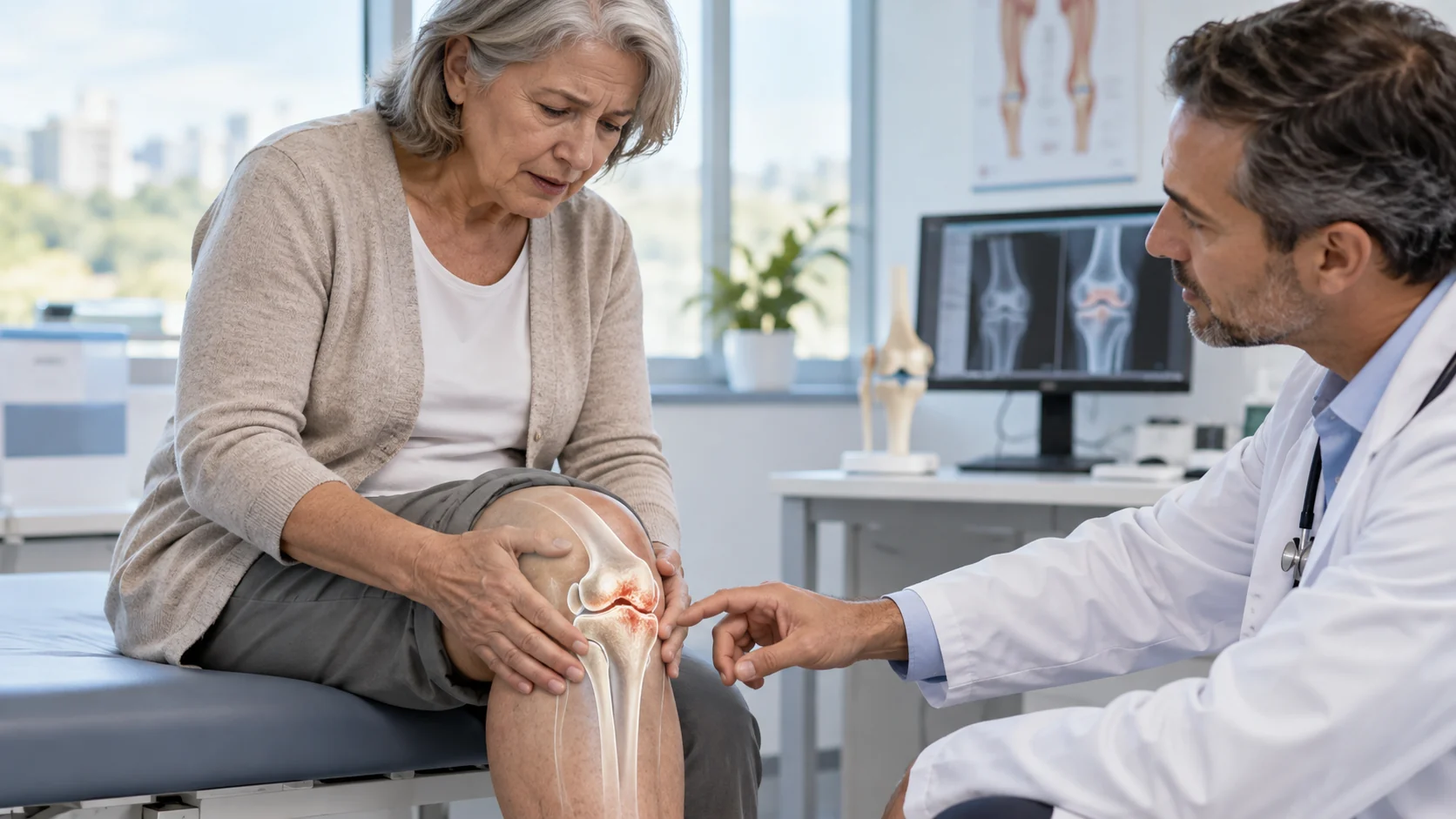
Clinical evaluation may be beneficial for individuals who experience knee pain after walking, climbing stairs, squatting, or prolonged sitting; or who have swelling, stiffness, or restricted mobility. If trauma, locking, or significant instability is present, the evaluation is planned in more detail.
How is it planned?
An attempt is made to determine the source of pain through history and physical examination; when necessary, X-ray, ultrasound, or MRI is added. Exercise, muscle strengthening, weight management, pain control, and in appropriate patients, injection or interventional options are prioritized according to personal goals.
What is knee osteoarthritis?
Knee osteoarthritis is a chronic joint disease in which articular cartilage, subchondral bone, synovium, and surrounding tissues are affected together. The severity of changes on X-ray may not always correlate directly with the person’s pain; daily function and physical examination findings are also important.
What symptoms can be seen?
- Pain that increases with walking or stairs
- Stiffness after prolonged sitting
- Swelling or effusion
- Decreased range of motion
- Difficulty squatting and standing up
- Decreased muscle strength around the knee
- Prominent pain in the patellofemoral region
What tests are needed?
In many patients, a detailed history and physical examination is the first step. When necessary, weight-bearing knee radiographs, ultrasound, or MRI can be used. MRI is not routinely required for every knee pain; it may be more meaningful in cases of locking, severe trauma, marked instability, surgical planning, or unexplained complaints.
Why is exercise important?
Current guidelines consider exercise, education, and personal self-management among the core treatment components in knee osteoarthritis. Strengthening, aerobic activity, and range-of-motion exercises can support pain and function. The intensity of the program should be adjusted according to pain level, conditioning, and accompanying diseases.
The role of weight management
Excess weight can increase mechanical load and metabolic inflammation on the knee joint. A 2025 network meta-analysis shows that significant weight loss in overweight or obese patients with knee osteoarthritis may be associated with improvement in pain and function. The goal is not only the number on the scale, but sustainable weight loss while preserving muscle mass.
Medications and topical treatments
Topical or oral anti-inflammatory medications can help with symptom control in some individuals. Age, kidney function, gastrointestinal, and cardiovascular risks must be taken into account in drug selection. Long-term use should be evaluated on an individual basis.
Intra-articular injections
Intra-articular options such as corticosteroids, hyaluronic acid, and PRP are used in different patient groups. Comparative studies in recent years report positive results with PRP and certain combinations; however, there are distinct differences among preparation methods, product characteristics, disease stage, and follow-up periods. Therefore, the choice of injection should not be made on the assumption that a single product is universally “best.”
The role of ozone applications
Intra-articular ozone is one of the methods investigated in knee osteoarthritis in terms of pain and function. Some studies and clinical experiences have reported positive results. Nevertheless, since there are differences among studies in terms of dose, sessions, comparator treatment, and patient selection, the application should be evaluated as part of the overall treatment plan in appropriate patients.
Radiofrequency and other interventional options
Genicular nerve radiofrequency applications may be evaluated as a non-surgical pain control option in some patients with chronic knee pain. Current reviews show positive signals; long-term comparative data continue to evolve. In advanced structural deformity and severe loss of function, orthopedic surgical evaluation may be required.
Our approach at our Bodrum clinic
In knee pain, we first attempt to differentiate whether the pain originates from intra-articular structures, the patellofemoral region, tendons/ligaments, or another source. Weight, muscle strength, walking capacity, effusion, joint motion, and imaging are evaluated together. The treatment plan is built as much as possible on exercise and function; injection or interventional methods are added to this foundation when needed.
Related guides
- Pain Treatment
- Weight Management and Metabolic Health
- Ozone: Diseases and Clinical Conditions
- Red Light Therapy and Photobiomodulation
References
- Moseng T, et al. EULAR recommendations for the non-pharmacological core management of hip and knee osteoarthritis: 2023 update. Ann Rheum Dis. 2024. PMID: 38212040.
- Shahid A, et al. Comparison of weight loss interventions in overweight and obese adults with knee osteoarthritis. Osteoarthritis Cartilage. 2025. PMID: 39233046.
- Rodríguez-Reyes G, et al. Nonoperative Management Recommendations for Knee Osteoarthritis. 2025. PMID: 41322884.
- Long-term effectiveness of intra-articular injectables in knee osteoarthritis. 2025. PMID: 40025522.
Written and medically reviewed by: Dr. Kerem Çağlayan
Last medical review: September 10, 2026
Disclaimer: This content is general health information; it is not a personal diagnosis or treatment recommendation.