
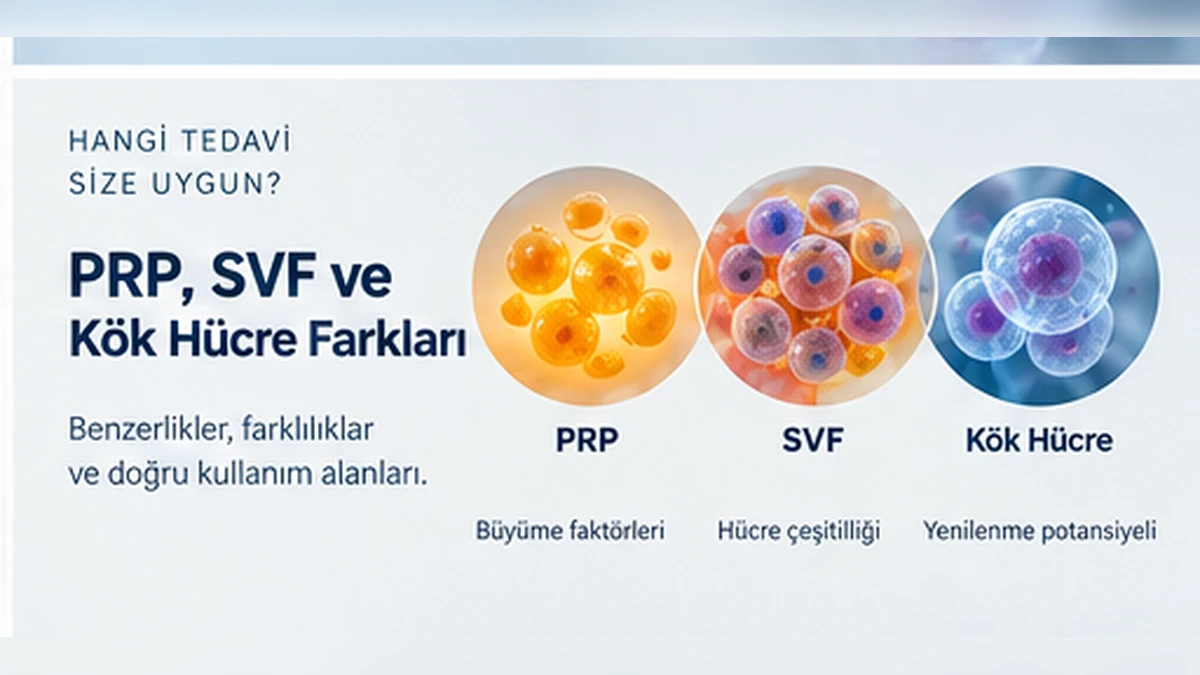
Basic comparison
| Method | Source | Primary content | Is it a stem cell? | Main research areas |
|---|---|---|---|---|
| PRP | The individual’s own blood | Platelet-rich plasma and biological signaling molecules | No | Knee, tendon, scalp, selected skin applications |
| PRF / i-PRF | The individual’s own blood | Platelets and fibrin matrix | No | Soft tissue and regenerative applications |
| SVF | Adipose tissue | Heterogeneous stromal, vascular, and cellular mixture | Not a pure stem cell product | Particularly knee osteoarthritis; research in other areas |
| Autologous micrograft | The individual’s own tissue | Micro-tissue particles and stromal/cellular components | Not defined as a stem cell on its own | Scalp, skin, and selected tissue applications |
| Defined/cultured cellular product | Autologous or allogeneic cell source | Specific cell populations | Yes depending on the product/cellular product | Varies depending on indication and regulations |
Which one is stronger?
There is no single answer to this question. “More cells,” “newer technology,” or a specific device name does not clinically translate to a better result. The appropriate method is selected based on diagnosis, target tissue, stage of the disease, safety, available clinical evidence, and current regulatory conditions.
Differences in knee osteoarthritis
PRP is one of the most studied orthobiologic methods in knee osteoarthritis. There are also randomized study and systematic review data for SVF and stromal cell-based therapies; some studies have reported positive signals regarding pain and function. However, preparation methods and product content are more heterogeneous in SVF and cellular products.
Differences in hair loss
There is broader clinical literature for PRP in androgenetic alopecia. Autologous micrograft and tissue-derived cellular approaches are a newer area of research. In hair treatment, accurate diagnosis, follicle reserve, and the baseline medical approach should be evaluated before regenerative injection.
Differences in skin and aesthetic applications
PRP and PRF have been investigated in skin quality, wound healing, and selected regenerative aesthetic applications. For cellular and tissue-derived products, evidence and regulatory status vary by application. Rather than broad claims such as “rejuvenation,” the target finding and the expected outcome need to be clearly defined.
Why is terminology important?
Defining a method differently from what it actually is affects the patient’s expectation and perception of risk. Referring to PRP as “stem cells,” to a mechanical micrograft product as “pure stem cells,” or approaching every SVF product as if it were the same cellular preparation is not scientifically accurate. Clear terminology is also an essential part of informed consent.
Our approach at our Bodrum clinic
We explain to the patient not only the treatment name, but also the source of the product to be administered and what it contains. The selection is made in conjunction with imaging and physical examination findings, the patient’s goals, alternative treatments, rehabilitation needs, and current evidence.
Related pages
Related cell therapies
Cell Therapies main showcase · PRP Treatment · Differences Between PRP, SVF, and Stem Cells · Application Areas
References
- AAPM&R guidance statement on platelet rich plasma for knee osteoarthritis. 2026. PMID: 41989317.
- Meta-analyses and level-I reviews of SVF/stromal cell therapies in knee osteoarthritis, 2025-2026.
- Regulation on Products Derived from Human Tissues and Cells and Centers Related to These Products, 2025 and 2026 implementation regulations.
Written and medically reviewed by: Dr. Kerem Çağlayan
Last medical review: September 14, 2026
Warning: This content is general health information; it does not substitute for an individual examination and treatment plan.