
What does this score mean?
The Confidence Index is an editorial methodology score indicating confidence in the clinical conclusions that can be drawn from this study, rather than the success rate of the treatment. While the controlled experimental design is positive, the study was conducted solely in rats and contains no human clinical data.
What did the study investigate?
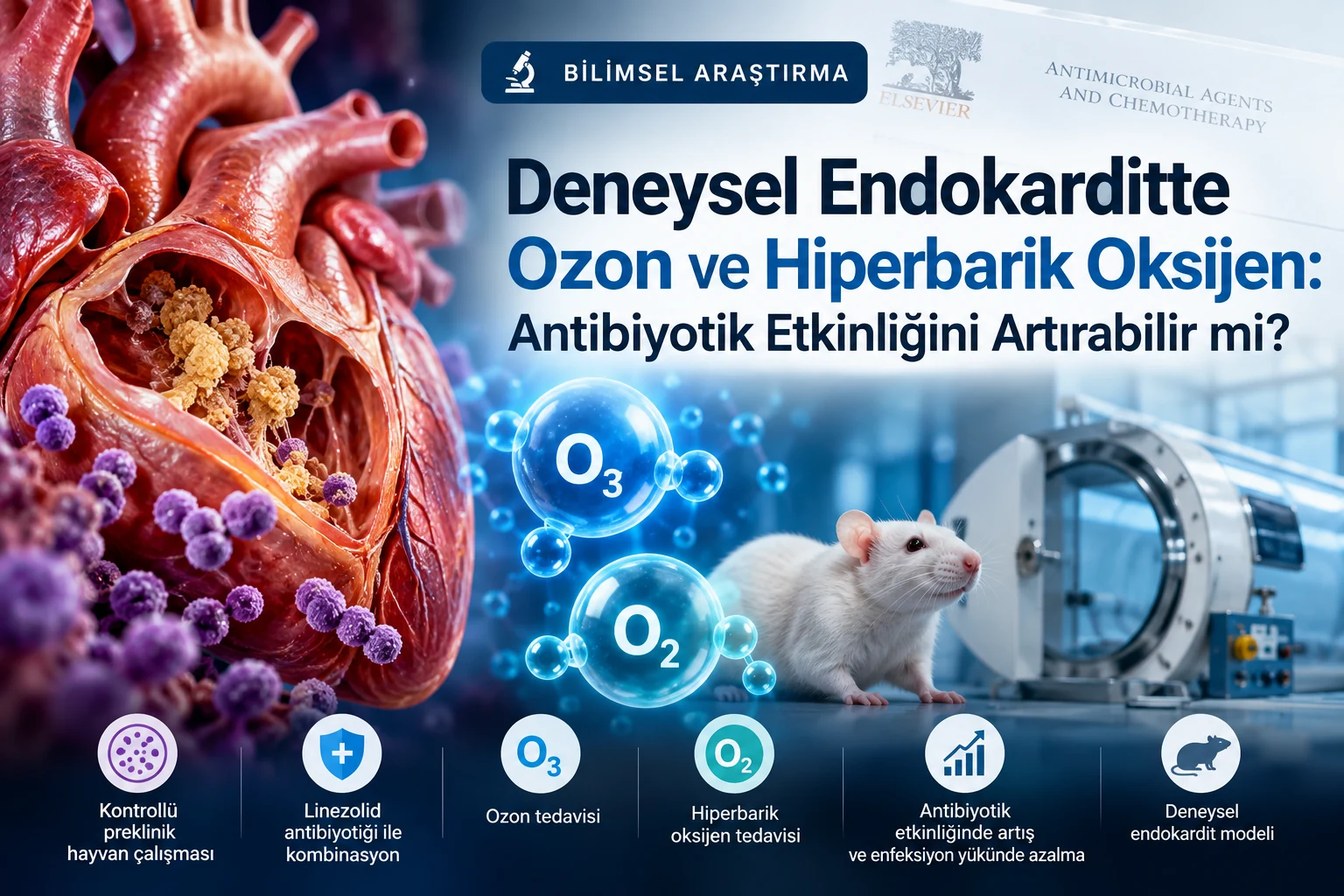
Researchers compared whether hyperbaric oxygen (HBO) or ozone (O3) administration enhanced the antibacterial efficacy of linezolid in an experimental Staphylococcus aureus endocarditis model.
How was it conducted?
A total of 56 adult male Wistar rats were divided into seven groups of 8 animals each: uninfected control, infected untreated control, linezolid, ozone, HBO, linezolid + ozone, and linezolid + HBO. The primary outcome measure was the bacterial colony load in aortic valve vegetations.
What was found?
The most effective approach in reducing bacterial colonies on the aortic valve was the linezolid + hyperbaric oxygen combination. This was followed respectively by linezolid + ozone, linezolid, hyperbaric oxygen, and ozone. The researchers reported that neither HBO nor ozone alone was sufficient; in this experimental model, HBO potentiated the effect of linezolid more than ozone did.
Limitations of the study
This study is a preclinical experiment conducted in rats, not humans. There were only eight animals in each group. The endpoint was primarily bacterial colony burden; it does not evaluate outcomes such as mortality, embolic complications, the need for valve surgery, or long-term clinical recovery in humans. Therefore, the findings cannot be directly translated to the treatment of human endocarditis.
What does it mean clinically?
The study provides mechanistic/preclinical evidence suggesting that adjuvant approaches aimed at enhancing antibiotic efficacy via oxygenation and oxidative biology can be investigated. However, in infective endocarditis, antibiotic therapy and surgical evaluation when necessary constitute the primary treatment. Based on this study, ozone or HBO should not be interpreted as an alternative to standard treatment.
What do we not know yet?
Whether ozone provides clinical benefit in human infective endocarditis, which administration protocol is safe and effective, and whether its addition to standard therapy reduces mortality or complications are not answered by this study. Controlled human clinical trials are needed to address these questions.
Reference
Özkan MTA, Vural A, Çiçek ÖF, Yener AÜ, Özcan S, Toman H, Ünver A, Saçar M. Is hyperbaric oxygen or ozone effective in experimental endocarditis? Journal of Surgical Research. 2016;202(1):66–70. DOI: 10.1016/j.jss.2015.12.006. PMID: 27083949.
Medical evaluation: This content was prepared for the purpose of evaluating scientific research; it is not personal diagnostic or treatment advice. · All Scientific Research
Detailed evaluation
In infective endocarditis, the presence of microorganisms at high densities within valve vegetations and the potential development of biofilm-like structures can hinder antibiotic efficacy. This experimental study is noteworthy for comparing, within the same model, the adjuvant effects on antibiotic therapy of HBO, which increases tissue oxygenation, and ozone, which possesses strong oxidant properties.
The ranking of the results is particularly important: the lowest bacterial load was achieved in the linezolid + HBO group, with linezolid + ozone ranking second. Ozone alone, on the other hand, showed a lower effect than the combination therapies. Therefore, the study does not support the conclusion that “ozone treats endocarditis”; a more accurate interpretation is that under experimental conditions, ozone added to linezolid may have reduced bacterial load more than linezolid monotherapy.
In a separate experimental S. aureus endocarditis study published in 2017, it was also reported that HBO enhanced the efficacy of tobramycin and reduced bacterial load in the aortic valve and other tissues. Although this strengthens preclinical biological consistency for HBO, it does not constitute direct clinical evidence for routine adjuvant use in human infective endocarditis.
Conclusion
This 2016 study reported that the combination of linezolid + HBO demonstrated the strongest antibacterial effect in an experimental endocarditis model, and that the combination of linezolid + ozone was also associated with a greater reduction in bacterial load than linezolid monotherapy. The findings are hypothesis-generating. Clinical studies are required to determine the efficacy and safety of ozone or HBO use in human endocarditis.