Which tissue does Endolifting target?
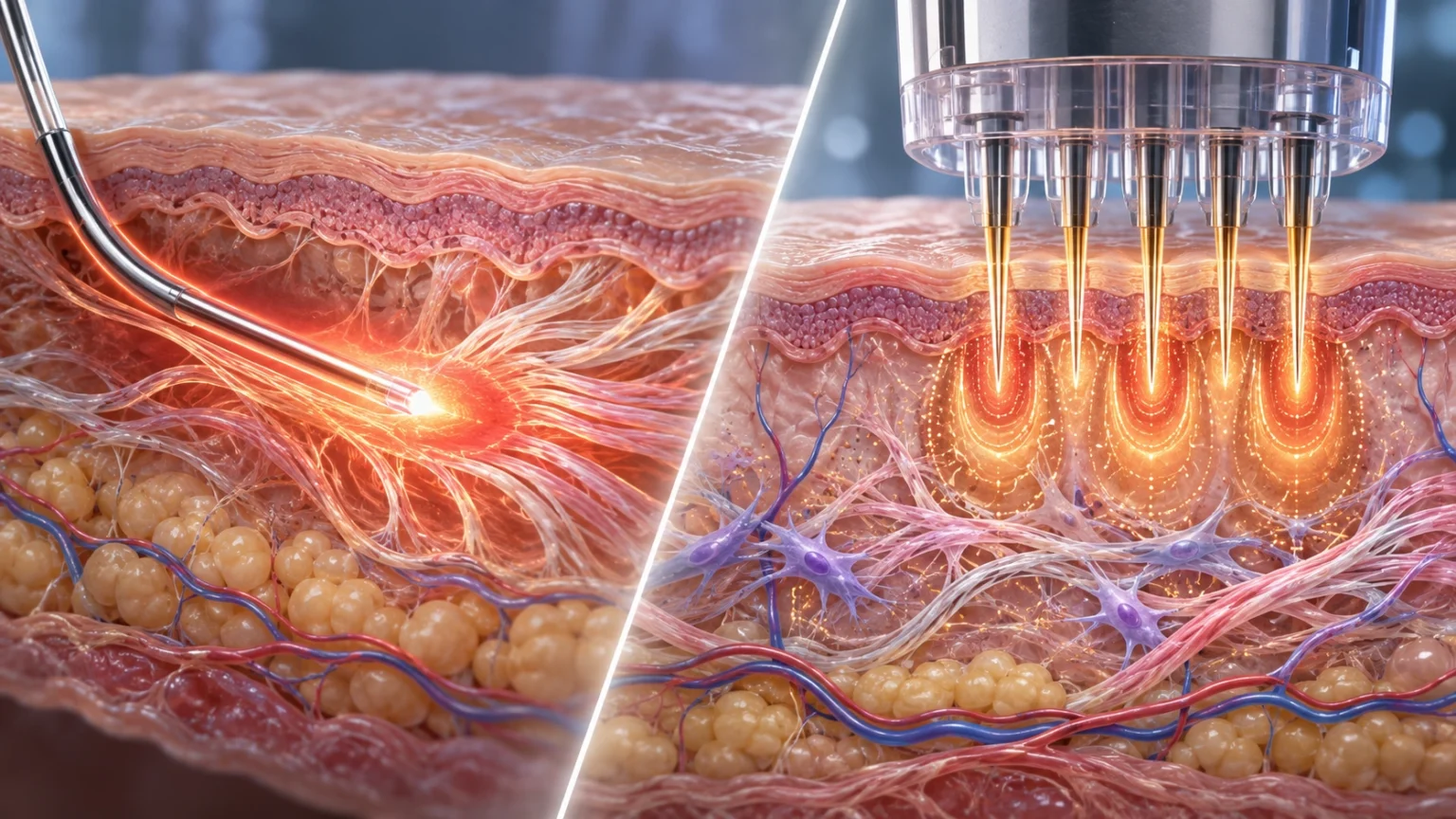
Endolifting, or intralesional 1470 nm diode laser, is applied by advancing a thin fiber in the subcutaneous plane. Due to the high affinity of the 1470 nm wavelength for water, it aims to create a thermal effect on subdermal collagen tissue and, in selected areas, adipose tissue. It can be evaluated in cases where skin laxity and localized fat accumulation coexist in areas such as the lower face, jawline, double chin, and neck.
How does RF microneedling work?
In RF microneedling devices, microneedles penetrate to a specific depth, and radiofrequency energy creates controlled thermal zones in the dermal/subdermal tissue. The goal is to stimulate collagen remodeling, improve skin texture, and, in selected cases, target acne scars, pore appearance, and mild-to-moderate laxity. Needle depth and energy can vary from device to device.
Is there a difference in terms of evidence?
Systematic reviews of RF microneedling published in 2026 show an expanding clinical database in facial rejuvenation and various dermatologic indications. For Endolifting as well, there are studies and systematic reviews evaluating facial and body applications. However, greater heterogeneity in terms of parameter standardization, control groups, and study quality has been reported in Endolifting studies. This situation does not rule out the clinical potential of the method; it only requires attributing the outcomes more carefully to device, technique, and patient selection.
Because there is no direct, large-scale randomized superiority study between these two methods, it would not be accurate to draw a general conclusion such as “Endolifting is better than RF” or vice versa.
In which cases may Endolifting stand out?
- If localized adipose tissue is present along with skin laxity in the double chin or jawline area
- If working in a deeper subdermal plane is desired
- If contour support in the lower face and neck is targeted
- If a targeted application with a fiber is suitable for the individual anatomy
In which cases may RF microneedling stand out?
- If skin texture and pore appearance are the primary concern
- If acne scars are present
- If fine lines and superficial-to-mid dermal remodeling are targeted
- If a homogeneous application over a broader area of the face is desired
Recovery time and side effects
Redness, edema, sensitivity, and temporary crusting may be observed after RF microneedling. After Endolifting, edema, sensitivity, bruising, and temporary irregularities along the treatment line may occur. In both methods, energy settings, anatomy, and practitioner experience are important for safety. Pigmentation tendency, active infection, bleeding risk, and medications used should be evaluated prior to the procedure.
Can they be used together?
Because they target different tissue layers, a combination with separated timing can be considered in some individuals. However, it is not necessary to perform both methods on every patient. Rather than performing more procedures, selecting the appropriate method for the right target is the priority.
Our approach at our Bodrum clinic
First, we evaluate the degree of skin laxity, adipose tissue, facial anatomy, skin quality, and the individual’s recovery time expectations. If lower face/double chin contouring is the priority, Endolifting; if skin texture, scarring, or more superficial tightening is targeted, RF microneedling may be more suitable. Both methods are compared with other options within the Skin Rejuvenation and Wrinkle Treatments plan.
Frequently asked questions
Which one is stronger?
“Stronger” alone is not the right comparison. The methods target different tissue layers. The most appropriate choice varies depending on the targeted concern, anatomy, and device parameters.
Can Morpheus8 be used instead of Endolifting?
Morpheus8 is an RF microneedling platform and does not have the same mechanism as Endolifting. While the two methods may be alternatives for certain goals, they serve different purposes in some patients.
Can results be achieved in a single session?
In some individuals, changes can be observed after a single application; however, the development time of results, session requirements, and longevity vary depending on the method, tissue, and individual healing response.
References
- Intralesional 1470 nm diode laser systematic review
- Endolift evidence and safety systematic review, 2025
- RF Microneedling for Facial Rejuvenation systematic review, 2026
- RF Microneedling dermatologic indications systematic review, 2026
Written and medically reviewed by: Dr. Kerem Çağlayan
Last medical review: September 10, 2026