What is shoulder impingement / subacromial pain?
Pain in the shoulder, especially during arm elevation, may be associated with the rotator cuff tendons, subacromial bursa, scapular control, and load capacity. The current approach uses the concept of multifactorial subacromial pain syndrome rather than the “impingement” of a single structure. Tendon, bursa, muscle, and cervical sources should be differentiated through examination.
How can laser help?
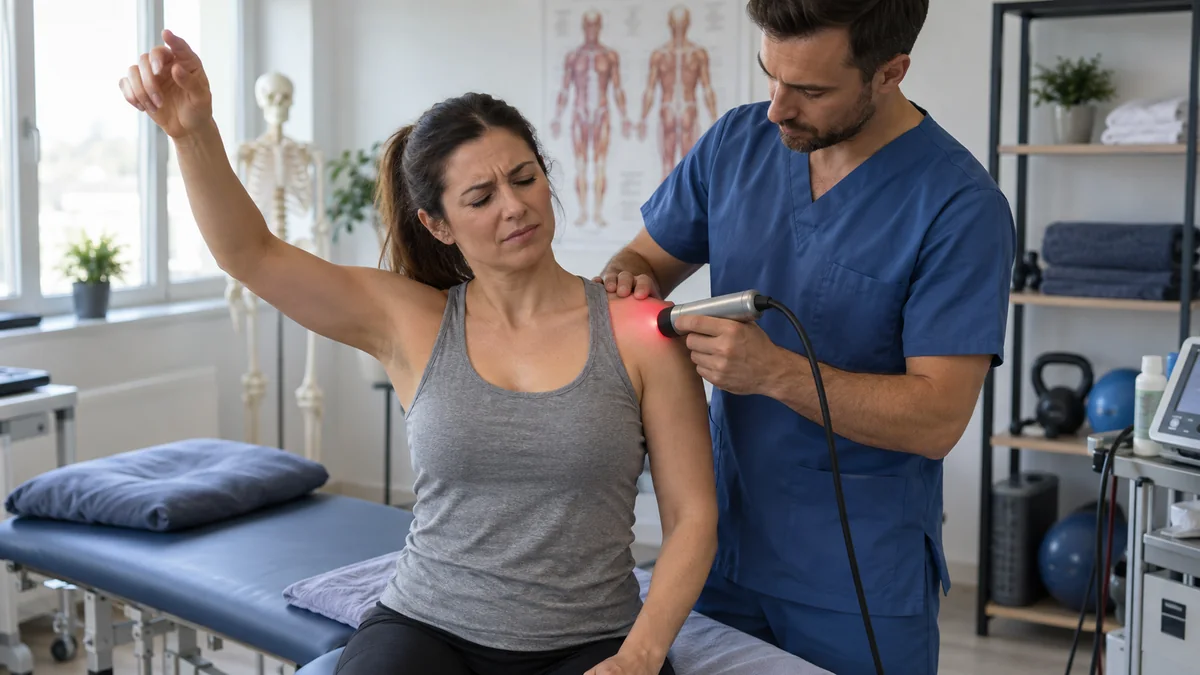
HILT and photobiomodulation aim to facilitate participation in exercise through pain modulation, local inflammatory response, and tissue metabolism. Laser does not resolve mechanical loading problems on its own; the primary goal is to reduce pain and increase the feasibility of rehabilitation.
The role of 980 nm
It can be considered as the primary wavelength for musculotendinous and periarticular targets around the shoulder. There are direct clinical studies with 810/980 nm HILT protocols.
The role of 1470 nm
1470 nm concentrates energy more superficially. For this reason, it is not the routine primary option in subacromial pain; it can be a selective adjunct wavelength in superficial concurrent targets, with careful monitoring of skin temperature.
What does the scientific evidence say?
Level of evidence: A. Positive results in terms of pain and function have been reported in systematic reviews, meta-analyses, and 810/980 nm HILT studies in subacromial pain and shoulder tendinopathies. However, dosage, device, and exercise protocols are heterogeneous.
Is laser sufficient on its own?
In most cases, no. Progressive strengthening of the rotator cuff and scapular muscles, load tolerance, and control of the painful arc represent the fundamental approach. Results should be monitored through strength, range of motion, and daily function in addition to pain.
Our approach at our Bodrum clinic
Our approach at our Bodrum clinic is to differentiate whether shoulder pain originates from the rotator cuff, bursa, joint, or neck, and then plan the use of 980 nm or, in selected superficial areas, 1470 nm according to the depth of the target tissue. Laser is positioned alongside exercise and load management.
When is a different evaluation required first?
In the event of an inability to raise the arm following acute trauma, significant loss of strength, dislocation, infection, or suspected full-thickness tear, further evaluation is required first.
Frequently asked questions
Is laser good for shoulder impingement?
It can support pain and exercise tolerance in selected patients; it cannot be said to eliminate the mechanical or structural cause on its own.
Which wavelength is more suitable?
For most shoulder targets, 980 nm is the primary option. 1470 nm is considered as an adjunct only for superficial targets.
References
- Subacromial pain and HILT literature
- 810/980 nm HILT clinical study
- Meta-analysis of HILT in tendinopathies
- 980/1470 nm physics comparison
Information
This content is for general health information purposes; it is not a personal diagnosis or treatment recommendation.