What is plantar fasciitis?
Plantar fasciitis is one of the most common causes of pain under the heel, which becomes particularly prominent with the first steps in the morning or upon standing up after prolonged sitting. Although commonly referred to as a “heel spur” among the public, the source of pain is not always a bone spur. Plantar fascia load, calf tightness, footwear, weight, and walking/running volume are important.
How can laser help?
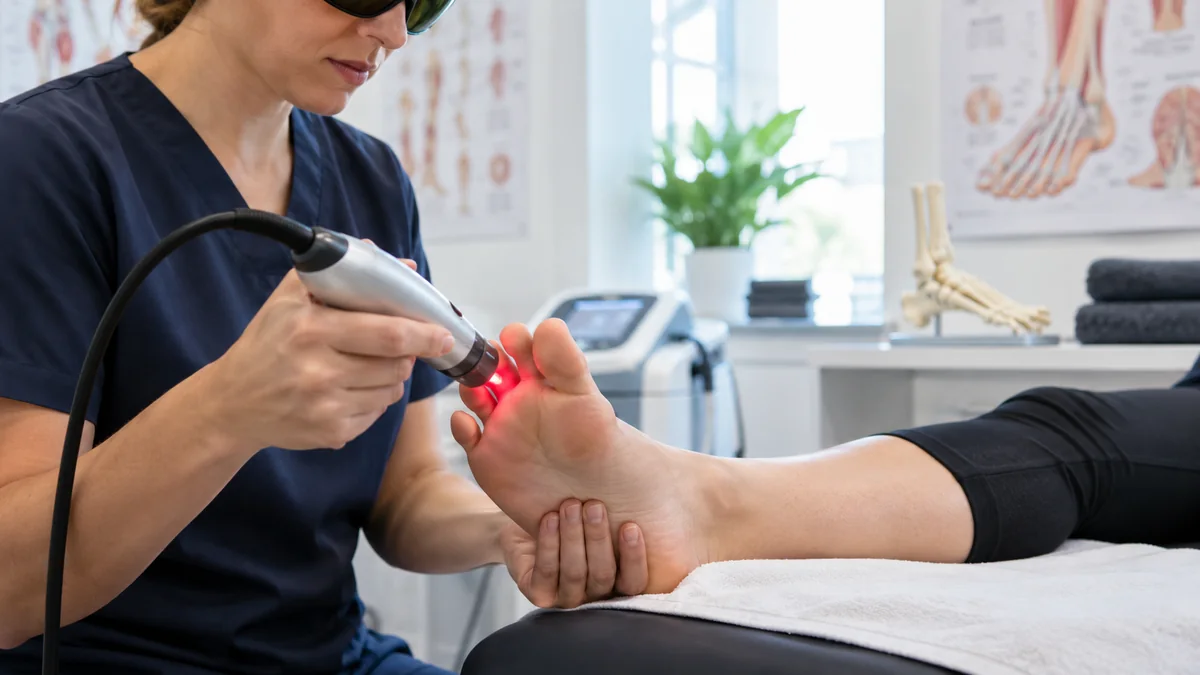
The effects of HILT and photobiomodulation on the analgesic effect, local inflammatory response, and peritascial tissue metabolism have been investigated. The clinical goal is to facilitate walking and exercise by reducing first-step morning pain and weight-bearing pain.
The role of 980 nm
It can be considered as the primary wavelength for the plantar fascia and surrounding soft tissues. Clinical studies of HILT at NIR wavelengths provide direct data on plantar fasciitis.
The role of 1470 nm
1470 nm is absorbed more strongly by water and produces a more superficial thermal effect. Because the plantar fascia is anatomically superficial, it may be helpful in selected areas; however, skin temperature and energy accumulation must be monitored carefully.
What does the scientific evidence say?
Level of evidence: A-. Randomized trials and current systematic reviews in plantar fasciitis show that laser can provide improvement in pain. In comparisons between methods such as HILT and shockwave, a clear superiority has not been demonstrated for every outcome.
Is laser sufficient on its own?
In most cases, no. Plantar fascia and calf load, footwear selection, weight, walking/running volume, intrinsic foot muscles, and calf strength are evaluated. Laser can be an adjunctive component of this plan that facilitates exercise and load management.
Our approach at our Bodrum clinic
Our approach at our Bodrum clinic is to differentiate whether heel pain originates from the plantar fascia, Achilles, nerve, fat pad, or bone, and then, in appropriate patients, to evaluate the 980 nm laser as the primary option and 1470 nm as a selective adjunctive wavelength for very superficial targets.
When is a different evaluation required first?
An advanced evaluation is required first in cases of inability to bear weight after trauma, fever-redness, neuropathic ulcer, sudden severe pain, or suspected stress fracture.
Frequently asked questions
Does a heel spur go away with laser?
In plantar fasciitis, laser can support pain relief and loading tolerance. The goal of treatment is not to dissolve the bone spur, but to facilitate the rehabilitation of the painful fascia and surrounding tissues.
980 nm or 1470 nm?
980 nm has a stronger clinical foundation as the primary wavelength. 1470 nm can be a selective adjunctive option for superficial plantar fascia targets.
References
- Current review of laser in plantar fasciitis
- Comparisons of HILT and other physical therapies
- Current review of musculoskeletal HILT
- 980/1470 nm physics comparison
Information
This content is for general health informational purposes.