What does this score mean?
The Confidence Index is not a treatment success rate, but an editorial methodology score that indicates to what extent the scientific finding evaluated on this page can be trusted. Study design, risk of bias, sample size, precision, direct applicability, reproducibility, transparency, and clinical relevance are evaluated together.
What did the study investigate?
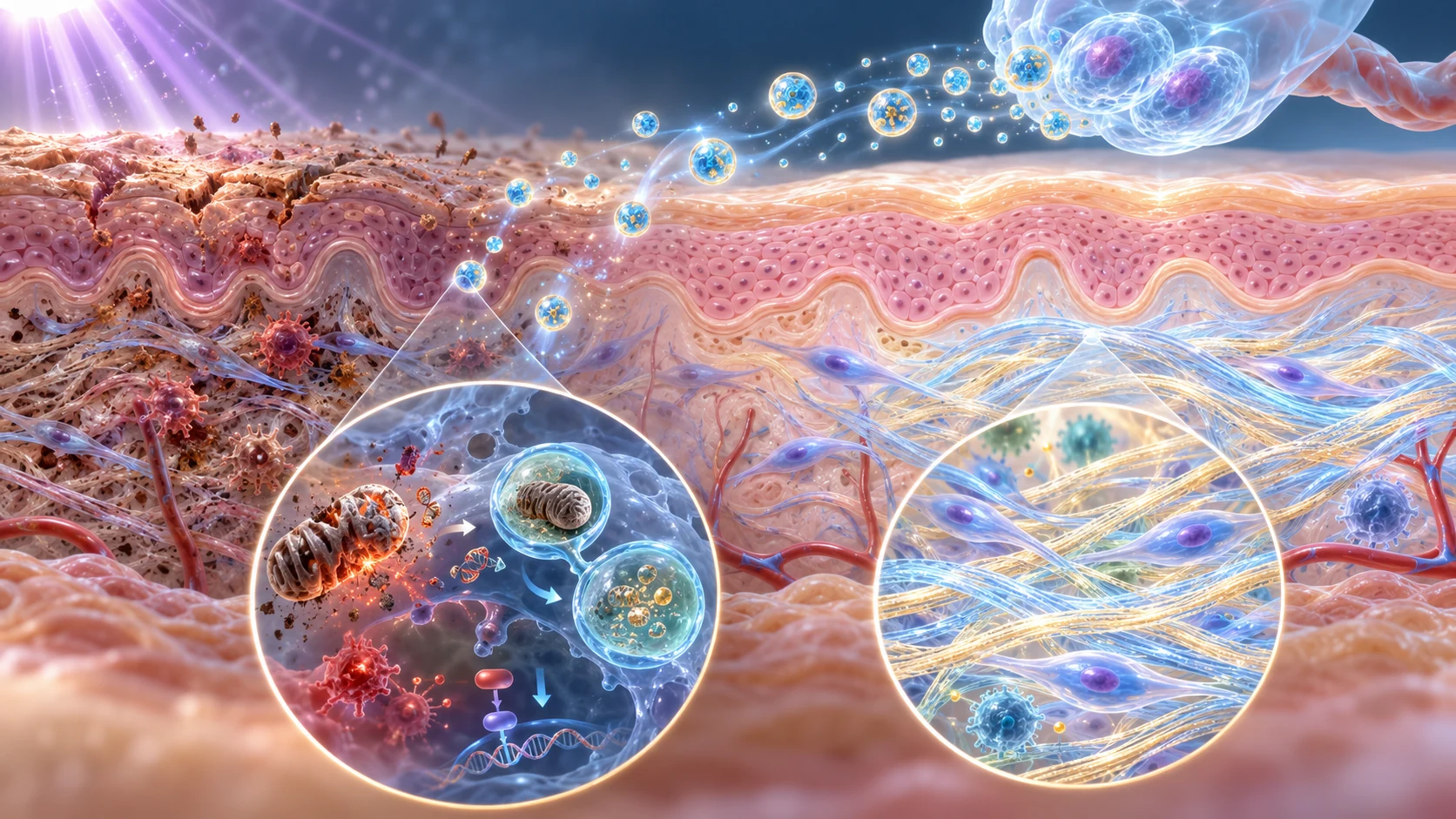
It investigated whether human umbilical cord MSC secretome affects mitophagy and the cGAS-STING inflammation pathway in UV-induced photoaging.
How was it done?
A UV-exposed mouse skin model and UVB-treated HaCaT keratinocytes were used; barrier, collagen, senescence, mitophagy, and inflammatory signals were measured. Mechanism testing was conducted with inhibitors.
What was found?
The secretome enhanced mitophagy, reduced mtDNA leakage and cGAS-STING activation; improvements were observed in inflammatory signals and photoaging markers.
Limitations of the study
The results come from animal and cell models, not from a human clinical trial. Product standardization, dosage, and long-term safety have not been determined.
What does it mean clinically?
The findings provide a mechanistic research basis for cell-free regenerative approaches; they should not be interpreted as evidence of skin rejuvenation efficacy in humans.
What do we not know yet?
The effective dose in human skin, manufacturing standards, durability, safety, and the actual effect on clinical appearance are not yet known.
Source
Full citations and links for the sources are preserved in the detailed evaluation section of this page.
Written and medically reviewed by: Dr. Kerem Çağlayan · Information about skin rejuvenation · All Scientific Research
Detailed evaluation
Research evaluation · September 18, 2026
Published in Aging Cell on September 11, 2026, the study investigated whether the secretome derived from human umbilical cord mesenchymal stem cells (hUC-MSC secretome) affects mitochondrial quality control and the cGAS-STING axis in UV-induced photoaging.
Models
A skin photoaging model in UV-exposed mice and a UVB-treated HaCaT keratinocyte cell line were used. Epidermal barrier, collagen integrity, senescence markers, and inflammatory signals were evaluated.
Mitophagy-cGAS-STING connection
The secretome increased mitophagy flux; reduced mitochondrial protein accumulation, and restricted cytosolic mtDNA leakage. In parallel, cGAS-STING activation and downstream inflammatory signals such as IL-6, IL-8, and IFN-β were suppressed.
Mechanism validation
When the mitophagy inhibitor Mdivi-1 was used, a significant portion of the protective effect was lost. The STING inhibitor H151 partially reversed this loss. This sequence supports the functional role of the mitophagy → mtDNA leakage → cGAS-STING chain.
Implications for aesthetics and longevity
It suggests that cell-free regenerative products may be developed in the future targeting mitochondrial quality control and sterile inflammation. However, clinical efficacy, dosage, and standardization in human skin have not yet been established.
Evidence quality
Preclinical: animal model + cell culture + mechanism validation.
Source
- Tang T, Lin M, Yang J, et al. The Secretome Derived From Human Umbilical Cord Mesenchymal Stem Cells Improves Skin Photoaging by Enhancing Mitophagy to Inhibit the cGAS-STING Pathway. Aging Cell. 2026;25(9):e70701. PMID: 42723546.
This content is a preclinical research evaluation.