
Quick answer
Hair loss is not a single disease. An accurate treatment cannot be selected without determining the type, duration, and distribution of the shedding, scalp findings, and potential triggers. Androgenetic alopecia, telogen effluvium, and scalp disorders require different approaches.
Who is it evaluated for?
Evaluation may be beneficial for individuals noticing marked thinning of the hair, thinning at the crown or frontal hairline, sudden diffuse shedding, hair breakage, or redness and itching on the scalp.
How is it planned?
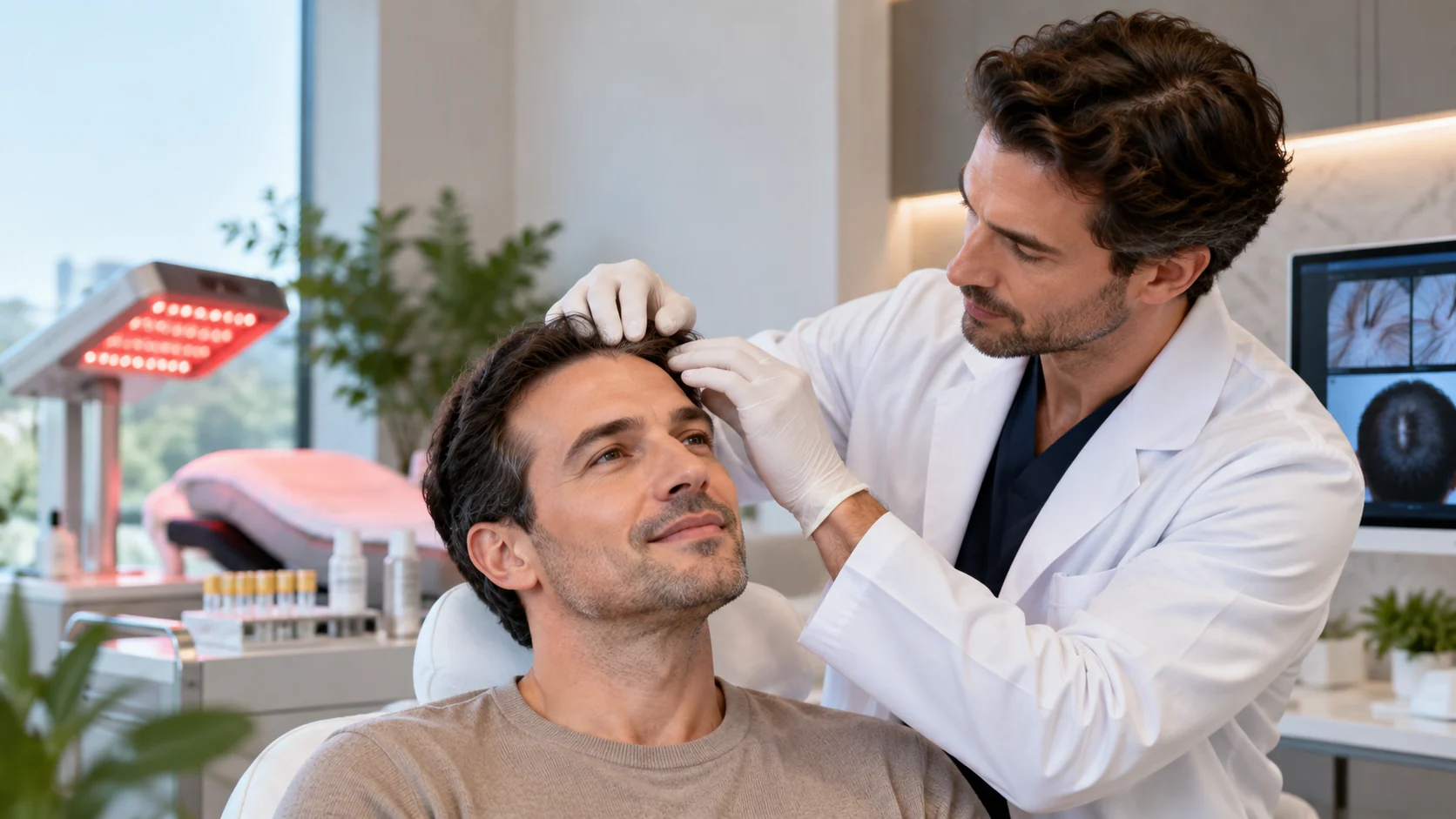
The shedding pattern, family history, scalp, and potential triggers are evaluated. When necessary, dermatoscopy and targeted laboratory tests are utilized; minoxidil, appropriate medical treatments, PRP/iPRF, microneedling, photobiomodulation, and supportive options are planned according to the diagnosis.
Key points
- Hair loss is not a single diagnosis; the type, distribution, duration, and triggers of shedding must be identified.
- Androgenetic alopecia and telogen effluvium do not progress in the same manner and do not require the same treatment plan.
- Rapid weight loss, iron deficiency, thyroid diseases, severe stress, and certain medications can contribute to diffuse hair loss.
- In scarring alopecias, early dermatological evaluation is important to limit hair loss.
How is hair loss evaluated?
When the shedding started, family history, changes at the hairline and crown area, itching/dandruff, hair breakage, and the presence of redness or scarring on the scalp are evaluated. When necessary, dermatoscopy and a dermatology consultation can clarify the diagnosis.
Androgenetic alopecia
It is one of the most common types of hair loss associated with genetic predisposition and androgen sensitivity. The frontal hairline and crown area in men, and more diffuse crown thinning in women, may be observed. Early treatment can contribute to the preservation of existing follicles.
Telogen effluvium
More diffuse shedding can be seen following illness, childbirth, stress, rapid weight loss, surgery, or nutritional issues. When the trigger is resolved, recovery of the hair cycle may take time; if shedding is prolonged, other accompanying causes should be investigated.
Which tests may be considered?
The same tests are not necessary for every individual. Based on the clinical history, a complete blood count (CBC), ferritin/iron status, TSH, B12, folate, vitamin D, zinc, and hormonal evaluations may be selected. Test results alone do not explain all causes of hair loss.
When is prompt evaluation needed?
If there is marked redness, pain, pustules, scarring on the scalp, loss of eyebrows/eyelashes, circular patches, or rapidly progressing localized hair loss, dermatological evaluation should not be delayed.
Our approach in our Bodrum clinic
We first determine the type and potential causes of hair loss; subsequently, we evaluate minoxidil, appropriate medical treatments, PRP/iPRF, microneedling, red light/PBM, and nutritional support according to an individualized plan.
Related guides
- Hair Loss and Hair Strengthening
- Red Light Therapy and Photobiomodulation
- Hair & Nail Cocktail
- Low Testosterone and Men’s Health
References
- Ntshingila S, et al. Androgenetic alopecia: An update. JAAD Int. 2023. PMID: 37823040.
- Perez SM, et al. Low-Level Laser and LED Therapy in Alopecia. Dermatol Surg. 2025. PMID: 39404126.
Written and medically reviewed by: Dr. Kerem Çağlayan
Last medical review: September 10, 2026
Disclaimer: This content does not constitute personal diagnostic or treatment advice.