
The first step in evaluating gynecomastia is to distinguish the components of breast enlargement: adipose tissue, glandular breast tissue, and skin laxity. Setting a goal of only “laser reduction” without making this distinction is not appropriate.
Gynecomastia and pseudogynecomastia are not the same thing
True gynecomastia is an increase in glandular breast tissue. Pseudogynecomastia, on the other hand, is breast enlargement dominated by adipose tissue. In many men, these two structures can coexist in varying proportions. The result that can be expected from Endolifting or a 1470 nm laser approach varies depending on the predominant tissue type.
In which cases can the 1470 nm laser be considered?
The 1470 nm laser approach may be considered in selected cases with fat-predominant pseudogynecomastia, mild-to-moderate skin laxity, and a limited glandular component. In dense fibrotic glandular tissue, advanced sagging, or significant displacement of the nipple–areola complex, a surgical or combined approach may be more appropriate.
Endolifting and laser-assisted lipolysis are not the same thing
The subdermal Endolifting technique used in the facial area and the laser-assisted lipolysis protocols investigated in gynecomastia should not be considered the same procedure. In gynecomastia studies, laser energy was used to process fat and selected glandular tissue, and in some protocols, it was followed by aspiration/liposuction. This distinction is important for the accurate interpretation of scientific data.
What did the 2026 randomized study show?
In a prospective, single-blind randomized controlled study published in 2026, 30 gynecomastia patients were divided into two groups. Fifteen patients underwent conventional suction-assisted liposuction, and fifteen patients underwent 1470 nm diode laser-assisted lipolysis. In the laser group, the glandular region was also treated, followed by liposuction.
The study reported higher BREAST-Q scores, better aesthetic evaluation, and lower postoperative pain in the laser group. This data supports the potential contribution of the 1470 nm laser to a combined gynecomastia surgery/lipolysis protocol. However, this study does not show that standard subdermal Endolifting alone treats all types of gynecomastia.
Physical examination, ultrasound, and hormonal evaluation
In new-onset, rapidly growing, painful, asymmetric, or clinically unexplained breast enlargement, aesthetic planning alone is not performed. History of weight changes, medications used, anabolic steroids, alcohol, liver-kidney diseases, and hormonal symptoms are investigated.
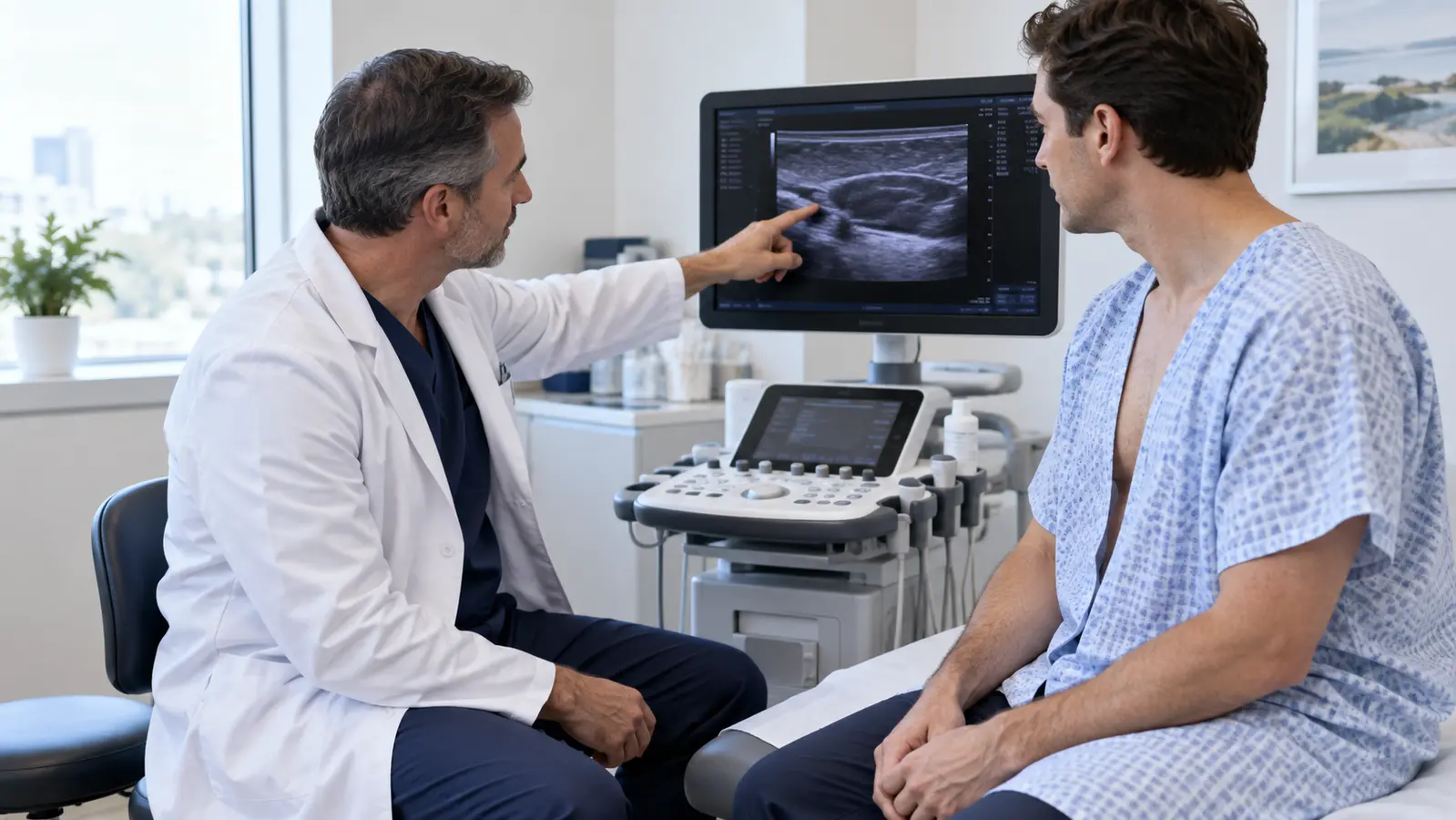
In cases where the distinction between gland and fat is not clear, or where asymmetry or a suspicious mass is present, ultrasound can contribute to planning. If clinically necessary, testosterone, estradiol, SHBG, LH, FSH, prolactin, TSH, hCG, and organ function tests can be evaluated. In the presence of a hard, unilateral, or suspicious mass, appropriate imaging and, when necessary, further investigation should not be delayed.
The difference between Endolifting, liposuction, and surgery
- Selected small-volume, fat-predominant cases: a minimally invasive laser approach may be considered.
- More pronounced excess fat: a combination of laser-assisted lipolysis and aspiration may be more predictable.
- Dense glandular tissue: glandular excision may be required.
- Significant skin excess and advanced sagging: more extensive surgical options may be considered.
Recovery and evaluation of results
Edema, bruising, tenderness, and temporary numbness may occur during the first few days. While volume changes can be noticed early, skin adaptation and collagen remodeling may become apparent over a longer period. Compression, return to exercise, and follow-up schedules are determined based on the scope of the procedure performed.
Risks
Edema, bruising, asymmetry, contour irregularity, seroma, pigmentary changes, infection, thermal injury, burns, inadequate reduction, or persistence of glandular tissue may occur. Safety is closely related to the correct anatomical plane, appropriate energy/fiber selection, sterile technique, and mastery of laser–tissue interaction.
Our approach in our Bodrum clinic
Our goal is not to apply the same procedure to everyone, but to differentiate the fat, glandular tissue, and skin components of the enlargement and select the method that can achieve an adequate result with minimal intervention. In appropriate cases, the 1470 nm laser approach, laser-assisted fat reduction, liposuction, glandular surgery, or combinations are compared.
Frequently asked questions
Does Endolifting completely resolve gynecomastia?
The outcome depends on the tissue type. In fat-predominant and mild-to-moderate cases, significant contour improvement can be targeted; it may not be sufficient on its own in dense glandular tissue.
Is ultrasound necessary for every patient?
No. It is more valuable in cases where the distinction between gland and fat is unclear, or where asymmetry or suspicious findings are present.
Can it be performed without liposuction?
It may be considered in selected small-volume and fat-predominant cases. In larger volumes, a combination with aspiration may be more appropriate.
Related content
General guide to Endolifting · The difference between Endolifting and laser lipolysis · Endolifting research and evidence map
References
- Wahdan WS et al. Evaluation of Aesthetic Outcomes After Laser-assisted Liposuction for Gynecomastia. Plast Reconstr Surg Glob Open. 2026. PMID: 41710183.
- Pozza C et al. Management of gynecomastia in adolescence and adults: SIAMS clinical practice guidelines. J Endocrinol Invest. 2026.
- Kanakis GA et al. EAA clinical practice guidelines—gynecomastia evaluation and management. Andrology. 2019.
- Vidal GP et al. Scientific evidence on the impact of endolaser in aesthetics: scoping review. Lasers Med Sci. 2025. PMID: 40116960.


