
What does this score mean?
The Confidence Index does not indicate the success rate of a treatment, but rather editorial confidence in the clinical conclusion that can be drawn from the available data. Human data, study design, mechanistic validation, peer-reviewed publication, and clinical endpoints are evaluated together.
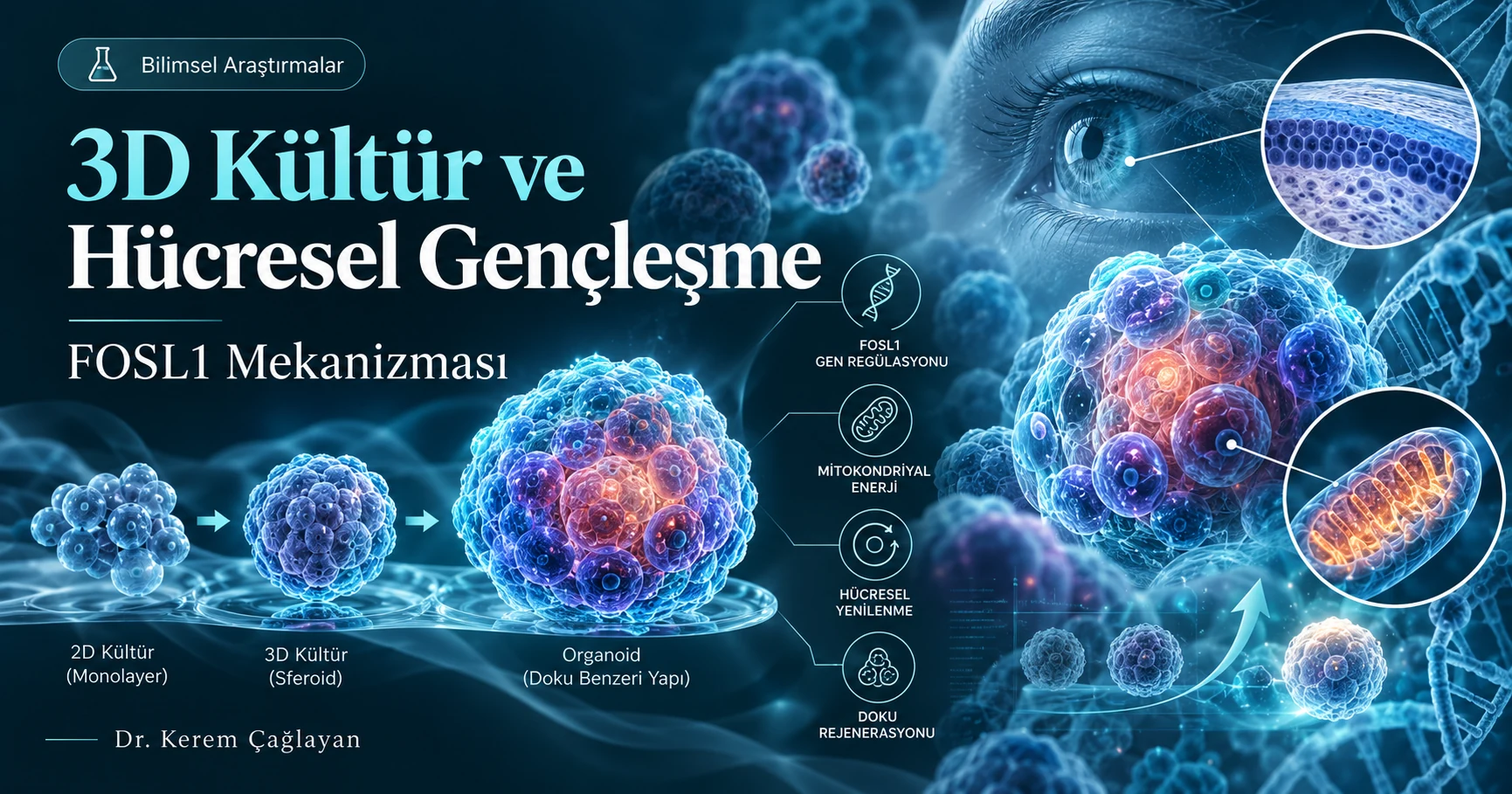
Brief conclusion: Three-dimensional culture improved indicators of proliferation, stemness, and mitochondrial function in laboratory-aged limbal niche cells. FOSL1 emerged as a mechanistic regulator; however, this result does not represent a stem cell rejuvenation therapy in humans.
What are limbal niche cells?
The limbus region, where the cornea and conjunctiva meet, is a specialized microenvironment for the stem cells that enable corneal epithelial renewal. Limbal niche cells (LNC) are stromal cells that play a role in regulating this microenvironment and can exhibit mesenchymal stem cell characteristics.
The problem: senescence during laboratory expansion
In cell-based regenerative therapies, cells must be expanded in culture to achieve sufficient numbers. However, serial passaging can lead to cellular senescence, loss of proliferation, and mitochondrial deterioration. This situation can limit the therapeutic potential of the cells.
How was the study conducted?
Researchers isolated LNCs from corneal limbal tissue obtained from donors aged 60–80 years. Traditional two-dimensional culture was compared with a three-dimensional droplet/spheroid culture system containing 50% Matrigel.
What changed in 3D culture?
In 3D culture, cells were shown to re-increase stemness markers such as SOX2, OCT4, and NANOG, elevate proliferative capacity via Ki67, and decrease senescence-associated markers such as SA-β-gal activity as well as p16, p21, p53, and γ-H2AX.
Why is FOSL1 important?
Single-cell RNA sequencing revealed that FOSL1 expression was markedly increased in the three-dimensional environment. Downregulation of FOSL1 in early-passage cells accelerated the aging phenotype, whereas its overexpression in late-passage senescent cells alleviated signs of senescence.
The mitochondrial connection
Loss of FOSL1 was associated with an increase in mitochondrial and cellular reactive oxygen species, a decrease in mitochondrial membrane potential, and structural deterioration. In contrast, increased FOSL1 better preserved mitochondrial integrity and function. This suggests that the 3D microenvironment, transcriptional regulation, and mitochondrial health may be interconnected.
Can we say “stem cells were rejuvenated”?
Because the reversal of certain replicative aging characteristics was demonstrated at the laboratory level, the term cellular “rejuvenation” can be used in a mechanistic context. However, this does not mean that systemic aging or clinical stem cell aging has been reversed in humans.
Significance for regenerative medicine
The most compelling message of the study is that not only a cell’s genetic program, but also the microenvironment and three-dimensional organization in which it resides can alter the aging phenotype. This approach may contribute to optimizing corneal regeneration and cell manufacturing protocols in the future.
Limitations
The study is at the in vitro level, and Matrigel is a research-grade biological matrix. Post-transplantation persistence, safety, tumorigenicity risk, immune response, and functional visual outcomes in humans were not answered by this study.
References
Wang X, Li S, Liu Z, et al. 3D Culture Reverses Limbal Niche Cell Replicative Aging via FOSL1 Upregulation. Aging Cell. 2026;25(9):e70705. DOI: 10.1111/acel.70705.
Medical evaluation: This content was prepared for the purpose of evaluating scientific research; it is not a personal diagnosis or treatment recommendation. Preclinical and experimental findings should not be interpreted as clinical treatment efficacy. · All Scientific Research