What is Achilles tendinopathy?
Pain that increases particularly with running, hills, stairs, or long walks, as well as morning stiffness, can be seen in the Achilles tendon. The problem may be in the midportion of the tendon or at its insertion point on the heel bone. The loading strategies for these two clinical forms may differ.
How can laser help?
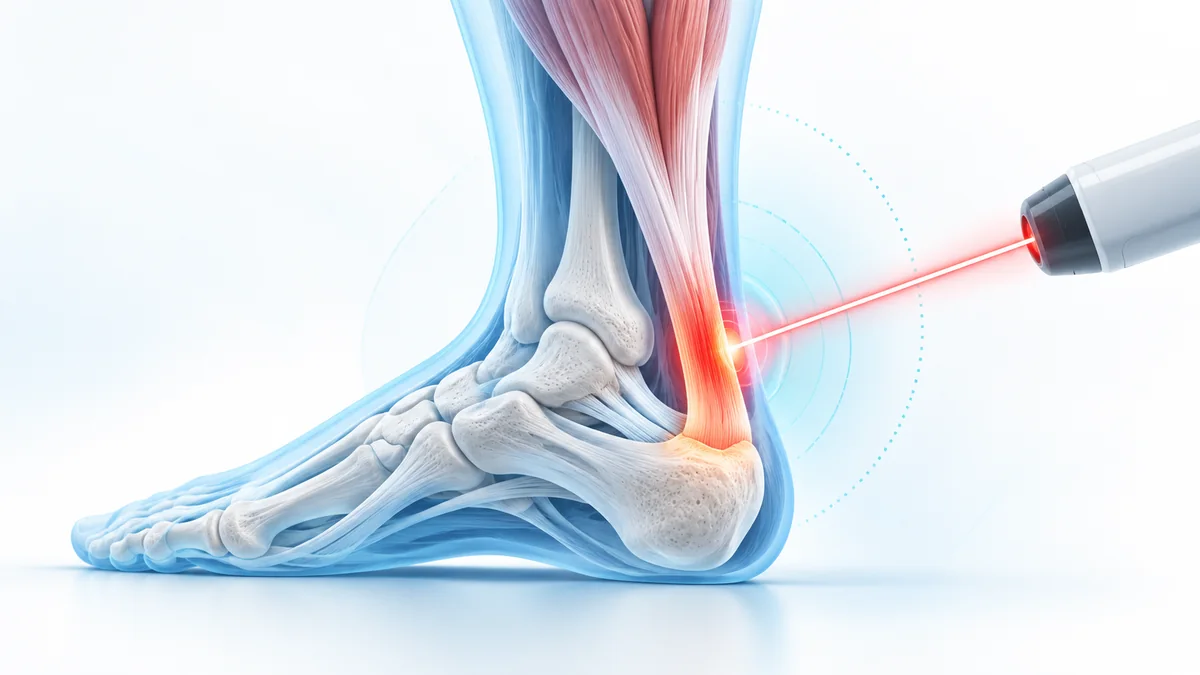
In high-power laser studies, effects on pain threshold, load-induced pain, and tissue metabolism have been investigated. The goal is not to passively ‘heal’ the tendon, but rather to reduce pain and facilitate participation in progressive loading.
The role of 980 nm
980 nm is a clinically rational wavelength for tendon targets that are close to the surface but possess a certain thickness, such as the Achilles tendon. An Achilles-specific high-power laser RCT reported positive results; however, the device/protocol used is not identical to 980 nm.
The role of 1470 nm
Due to the strong water absorption of 1470 nm, its effect is more superficial. It may be considered for selected targets such as the Achilles paratenon or very superficial insertional tenderness; there is no direct clinical study data on 1470 nm for Achilles tendinopathy.
What does the scientific evidence say?
Evidence level: B+. In a 2016 randomized placebo-controlled study, high-power laser demonstrated better results than placebo in terms of pain and pain threshold during certain loading activities in chronic Achilles tendinosis. Because the study had a small sample size and there is no standardization among protocols, the evidence is supportive but not definitive.
In whom can it be considered?
- In chronic midportion Achilles tendinopathy
- In insertional Achilles pain when the anatomical target is appropriate
- When pain control is needed at the start of exercise
- When acute full-thickness rupture has been ruled out
Our approach at our Bodrum clinic
Our approach at our Bodrum clinic is to differentiate Achilles pain in terms of midportion, insertional, paratenon-derived origin, or the possibility of a partial tear. If laser is applied, 980 nm is evaluated as the primary wavelength for most tendon targets, whereas 1470 nm is considered a selective option only for very superficial accompanying foci. We combine the treatment with calf strengthening, eccentric/heavy slow resistance loading, and adjustment of walking, hill, and running loads.
When is a different evaluation required?
In the event of a sudden snapping sensation, pronounced loss of strength, a positive Thompson test, severe swelling, or inability to walk following trauma, evaluation for a rupture is required first.
Frequently asked questions
Is rest sufficient for Achilles pain?
Complete rest for a long period is generally not preferred; the tendon needs to be reloaded in a controlled manner.
Does laser replace exercise?
No. Laser is an adjunct treatment complementary to the progressive loading program.
980 nm or 1470 nm?
980 nm is more rational in terms of the deeper tendon target. There is no direct clinical efficacy data for 1470 nm.
References
- PMID 27330704 — High power laser for treatment of Achilles tendinosis, randomized placebo-controlled study.
- PMID 39652213 — HILT musculoskeletal pain umbrella review.
Disclaimer
This content is general health information; a personalized treatment plan is established after an examination.