Who is it evaluated for?
It is suitable for individuals experiencing hair thinning, heavy shedding, thinning in the hairline or crown area, and who want to clarify the cause of the loss.
How is it planned?
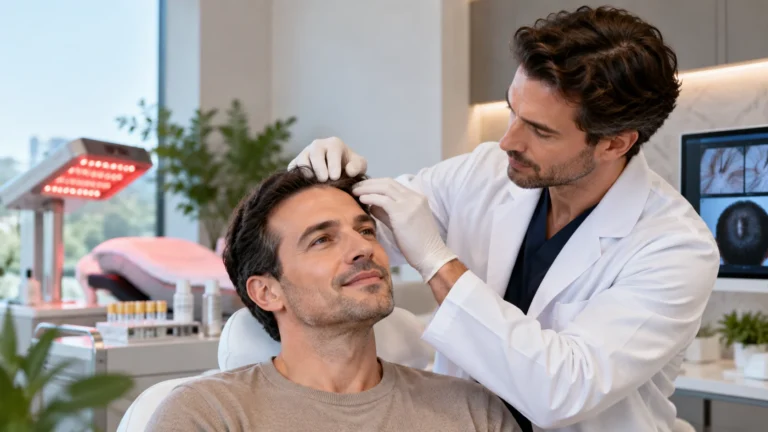
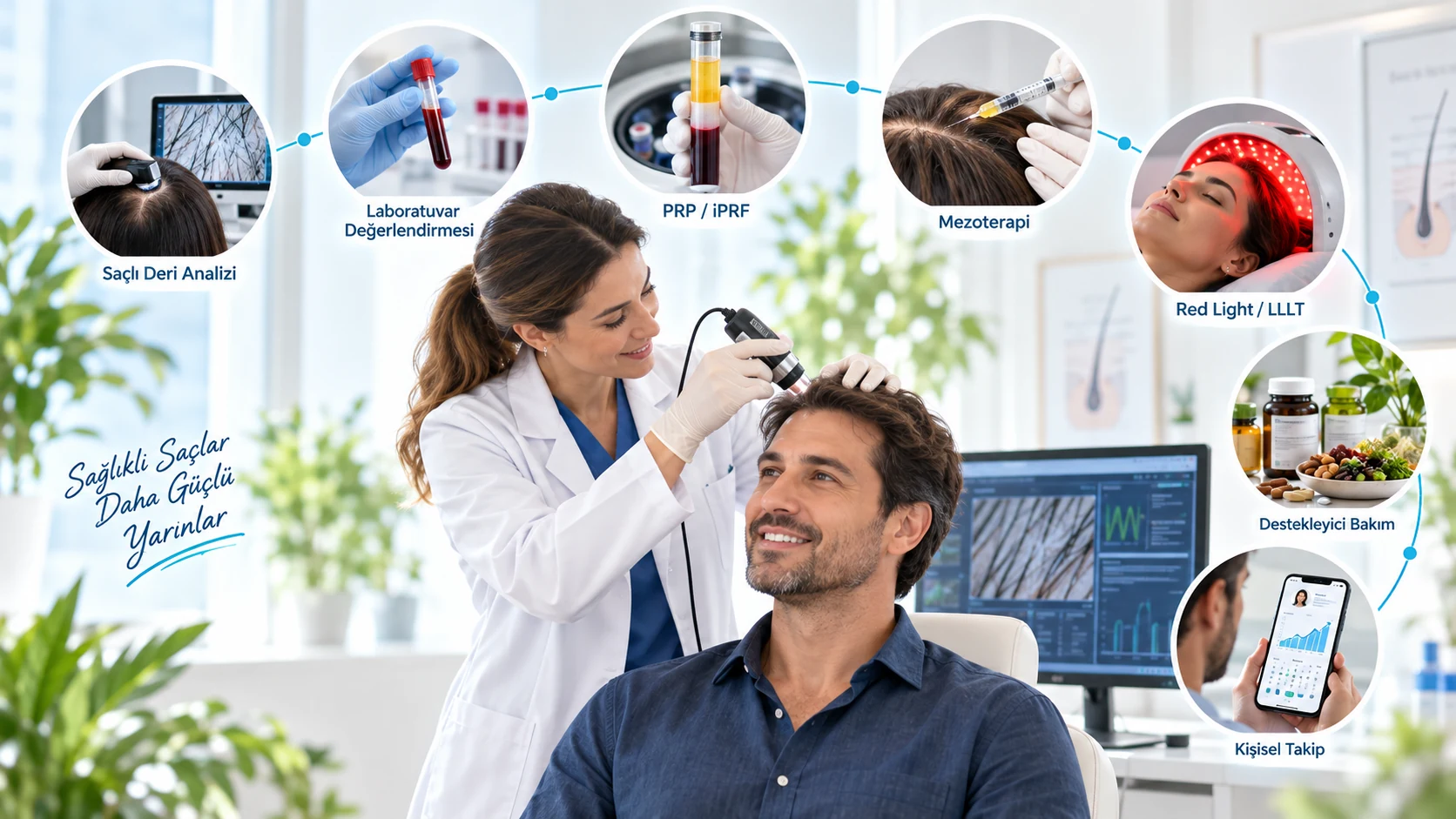
First, the type of hair loss and the scalp are evaluated; laboratory tests are added when necessary. Treatment is planned according to the cause and stage as an appropriate combination of medical options, PRP/iPRF, microneedling, photobiomodulation, and lifestyle support.
Key points
- Hair loss is not a single disease; treatment is planned by determining the underlying cause.
- In androgenetic alopecia, treatment aimed at protecting follicles in the early stages may be more advantageous.
- Rapid weight loss, inadequate protein intake, iron deficiency, thyroid dysfunction, and certain medications can trigger widespread hair loss.
- There are positive clinical studies for PRP/iPRF, microneedling, and Red Light/PBM; results may vary depending on the protocol used and patient selection.
- In hair treatment, it is more meaningful to evaluate results over months rather than weeks in most cases.
Why does hair fall out?
The hair follicle operates within a cycle consisting of growth, transition, and resting phases. While genetic and hormonal influences can lead to progressive follicle thinning over time; illness, high fever, surgery, severe stress, childbirth, rapid weight loss, energy-protein malnutrition, and certain medications can trigger more diffuse shedding.
Androgenetic alopecia
It is one of the most common causes of male- and female-pattern hair loss. Genetic predisposition and androgen sensitivity contribute to the progressive thinning of follicles. The goal of treatment is to preserve existing follicles as much as possible, slow down miniaturization, and support hair density in appropriate candidates.
Telogen effluvium
Diffuse hair shedding can be seen weeks to months after high fever, surgery, severe stress, childbirth, rapid weight loss, iron deficiency, or significant nutritional changes. When the trigger is resolved, the hair cycle may recover over time. If shedding persists for a prolonged period, whether androgenetic alopecia or other causes coexist is additionally evaluated.
Which tests may be considered?
Not every person requires the same laboratory panel. Based on history and physical examination, complete blood count, ferritin and iron status, TSH, B12, folate, vitamin D, zinc, and other parameters may be evaluated. In women, if signs of hyperandrogenism such as acne, increased body hair, or menstrual irregularity are present, hormonal evaluation may come into question. The ferritin result is interpreted not in isolation, but alongside the complete blood count, inflammatory status, iron indices, and clinical presentation.
Minoxidil
Topical minoxidil is one of the most commonly used options in androgenetic alopecia. In the initial period, a temporary increase in shedding may be observed, and visible changes may take time to emerge. Oral low-dose minoxidil may be evaluated under physician supervision in certain individuals; an individualized risk assessment is conducted regarding blood pressure, heart rate, edema, and other potential effects.
Finasteride and other antiandrogenic options
Finasteride is one of the effective treatment options in male androgenetic alopecia. Sexual side effects, fertility plans, and personal preferences are discussed during the treatment decision. In women, spironolactone or other antiandrogenic approaches may be evaluated in selected cases; pregnancy potential and contraception planning are important.
PRP and iPRF
PRP and iPRF are based on applying products containing platelets and growth factors prepared from the individual’s own blood to the scalp. Clinical studies have reported positive results in hair density and thickness in certain patient groups. The preparation system, platelet concentration, activation, injection technique, and session intervals can affect the outcome; therefore, the mere statement that “PRP was performed” does not make all protocols equivalent.
Red Light / photobiomodulation
LLLT/PBM is an increasingly researched non-invasive modality for androgenetic alopecia. Systematic reviews and meta-analyses have reported positive outcomes in terms of hair density with certain devices and protocols. There is also data suggesting that it may provide an additive benefit in combination studies with minoxidil.
For detailed information, you can review the Red Light and Hair Loss and Red Light Therapy and Photobiomodulation pages.
Microneedling
Microneedling can influence tissue response and the penetration of topical treatments by creating controlled microchannels in the scalp. Studies exist on its use alone or in combination with methods such as minoxidil/PRP. Depth of application, sterility, and active scalp diseases must be taken into account.
Nutrition, weight loss, and supplements
Hair production requires adequate energy, protein, iron, zinc, and other micronutrients. Insufficient intake of protein and total energy, especially during periods of rapid weight loss, can increase the risk of telogen effluvium. Supplements are selected based on actual deficiency, nutritional status, and clinical goals as much as possible; rather than starting multiple products simultaneously, it is determined which factor is important.
In terms of hair loss associated with rapid weight loss or GLP-1/GIP treatments, the Weight Management and Metabolic Health page may also be helpful.
Ozone and complementary scalp applications
Scalp ozone and other local support applications are used with goals such as circulation, tissue response, and post-procedure recovery. Clinical research in this field continues to evolve. In appropriate individuals, ozone can be planned as a complementary option aimed at scalp and tissue support, rather than replacing the primary hair loss treatment.
Related guide: Ozone Before and After Hair Transplantation.
Our approach in our Bodrum clinic
We do not approach hair loss solely through “hair strengthening serums.” First, the hair loss type, onset time, family history, scalp examination, weight change, nutrition, medications, and laboratory tests when necessary are evaluated.
Afterward, minoxidil or appropriate antiandrogenic treatments, PRP/iPRF, microneedling, Red Light/PBM, nutritional support, and selected complementary methods can be combined according to individual goals. For details on injection-based support options for the scalp, you can review our Hair Mesotherapy and Scalp Regeneration guide. Performing serial follow-ups with baseline photographs and, whenever possible, standardized hair density assessments allows us to observe true change more accurately.
Frequently asked questions
Can low ferritin cause hair loss?
Iron deficiency can contribute particularly to diffuse hair loss. Ferritin alone does not explain all hair loss; it is evaluated together with a complete blood count, iron status, and clinical history.
Can Red Light support hair growth?
There is positive human data in androgenetic alopecia. The expected benefit may vary depending on the device used, dosage, the stage of hair loss, and accompanying treatments.
Is PRP or iPRF better?
Positive clinical results have been reported with both methods. Their preparation methods differ, and direct comparative research is evolving; the choice can be made based on the type of hair loss, the system used, and clinical goals.
When are the results of hair treatment evaluated?
Because the hair growth cycle is slow, it is more meaningful to evaluate most treatments over months rather than within a few weeks. Follow-up intervals may vary depending on the method used.
Related content
- Hair loss
- Red Light and hair loss
- Red Light therapy
- Hair transplantation and ozone support
- Weight management and metabolic health
- Healthy aging and Longevity
References
- Ntshingila S, et al. Androgenetic alopecia: An update. JAAD Int. 2023. PMID: 37823040.
- Perez SM, et al. Low-Level Laser and LED Therapy in Alopecia: A Systematic Review and Meta-Analysis. Dermatol Surg. 2025. PMID: 39404126.
- Mawu FO, et al. LLLT plus topical minoxidil versus minoxidil monotherapy in androgenetic alopecia. Lasers Med Sci. 2025. PMID: 40826200.
Written and medically reviewed by: Dr. Kerem Çağlayan
Last medical review: September 10, 2026
Visual note: The page image is a representative clinical visual created with artificial intelligence.
Disclaimer: This content is for general medical information purposes only; it does not substitute for personalized diagnosis or treatment advice.
Clinical evaluation in Bodrum: To discuss whether the procedure is suitable for you, you can use the Bodrum Clinic and Appointment and Contact pages.