What does this score mean?
The Confidence Index does not indicate the success rate of the treatment, but rather the editorial confidence in the clinical conclusion that can be drawn from the available data. Human data, study design, mechanistic validation, peer-reviewed publication, and clinical endpoints were evaluated together.
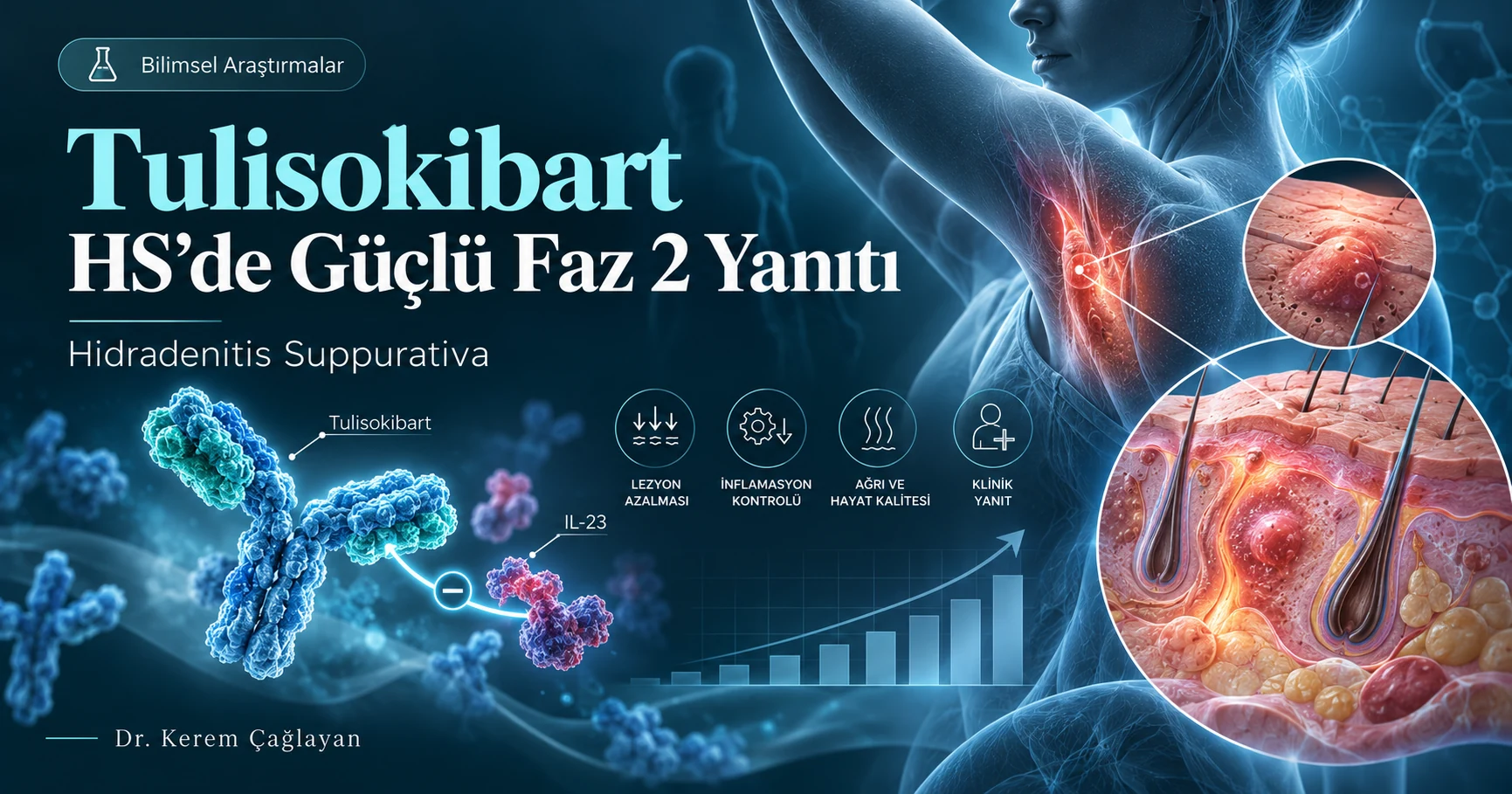
Brief result: High-dose tulisokibart approximately doubled the proportion of patients achieving at least a 50% reduction in inflammatory lesions at 16 weeks compared with placebo. While the signal is strong, the drug is still investigational and long-term results are awaited.
Why is hidradenitis suppurativa a difficult disease?
Hidradenitis suppurativa (HS) is a chronic inflammatory skin disease characterized by recurrent painful nodules, abscesses, tunnels, and scars. The disease does not merely consist of skin lesions; it can cause pain, drainage, infection-like flares, restricted mobility, and marked impairment in quality of life.
What is tulisokibart?
Tulisokibart is an investigational monoclonal antibody targeting the TL1A pathway, which plays a role in inflammatory and fibrotic signaling. The same biological pathway is also being investigated in inflammatory bowel diseases.
What was found in the phase 2 study?
In the mid-stage study announced by Merck, approximately 72% of patients receiving high-dose tulisokibart achieved at least a 50% reduction in inflammatory lesions at week 16, compared with 35% in the placebo group.
For the criterion of at least a 75% reduction, which indicates a deeper response, the rates were reported as approximately 41% versus 15%. These differences suggest that the biological effect of the treatment may not be merely a minor statistical change.
Safety profile
According to the company’s announcement, safety during the study period generally appeared comparable to placebo. However, the phase 2 sample size may not be sufficient to evaluate rare adverse events or those occurring over the long term.
What do these results mean for current biologic treatments?
Biologic agents targeting the TNF and IL-17 axes are currently important options in HS treatment. Targeting TL1A offers the possibility of intervening in the inflammation and tissue remodeling components of the disease from a different point. However, response rates from different studies should not be directly compared with one another.
Limitations of the study
The results belong to a mid-stage clinical study and are not full, long-term phase 3 evidence at this stage. A 16-week response alone does not provide sufficient information regarding disease activity over the years, tunnel formation, scarring, need for surgery, or sustained improvement in quality of life.
What does it mean clinically?
The data provide a strong phase 2 signal that a new immunological target may be clinically meaningful, particularly for moderate-to-severe HS. However, tulisokibart is not yet an approved HS treatment; phase 3 efficacy and safety data must be awaited.
References
Reuters, September 30, 2026. Merck experimental skin disease drug meets main goal in mid-stage study.
Medical evaluation: This content has been prepared for the purpose of evaluating scientific research; it is not a personalized diagnostic or treatment recommendation. Preclinical and experimental findings should not be interpreted as clinical treatment efficacy. · All Scientific Research