What causes metatarsalgia?
Prolonged standing, running, high-heeled or narrow shoes, excessive loading on the forefoot, inflammation around the metatarsal head, and various structural problems can cause pain in the forefoot. Morton’s neuroma should be evaluated as a distinct neuropathic cause.
How can laser help?
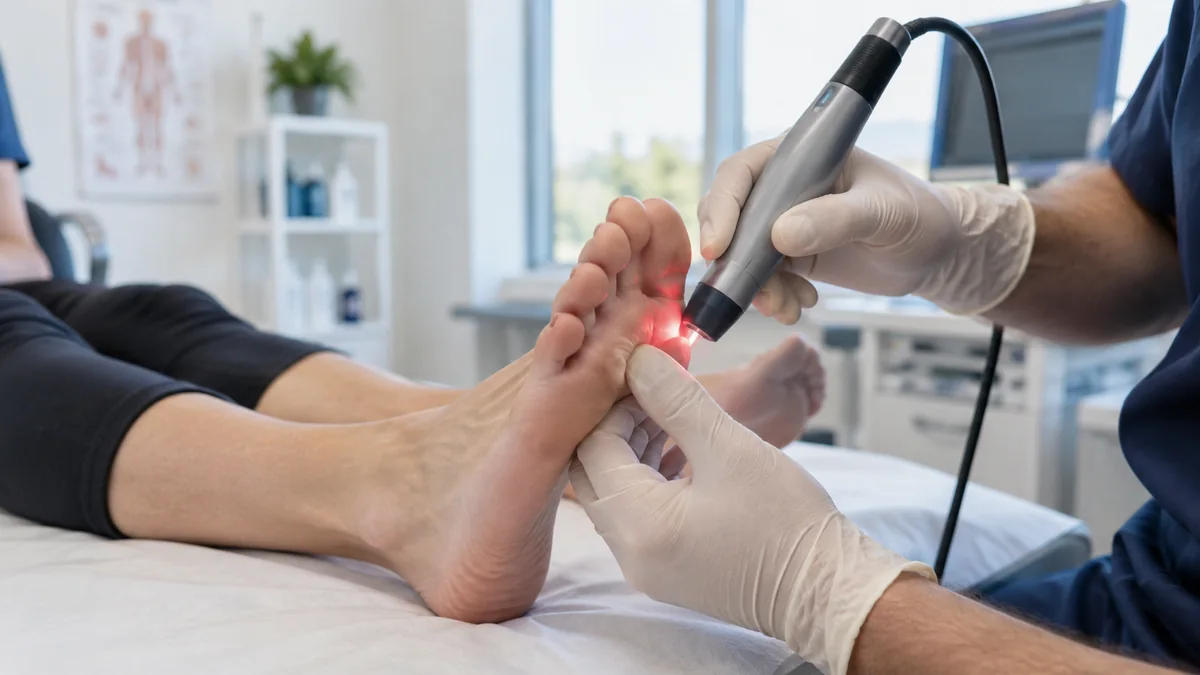
Once the diagnosis is clarified, it may be considered as an adjunct for symptom control in superficial soft tissue or periarticular pain. Laser alone is not sufficient without correcting pressure distribution, footwear, and biomechanical causes.
The role of 980 nm
It can be used in superficial-to-mid-depth soft tissues in the forefoot; there is no evidence of clinical superiority specific to metatarsalgia.
The role of 1470 nm
It has a very superficial thermal characteristic. In applications on the sole of the foot close to the skin and fat pad, the thermal load must be managed carefully; there is no direct efficacy data.
What does the scientific evidence say?
Evidence level: D+. No reliable 980/1470 nm RCT data specific to metatarsalgia was identified. General orthopedic pain and photobiomodulation data provide only indirect support.
Our approach at our Bodrum clinic
At our Bodrum clinic, causes such as metatarsal load distribution, footwear, calluses, plantar plate, stress injury, and Morton’s neuroma are differentiated in forefoot pain. Laser is evaluated only if the target tissue has been identified, in addition to footwear, load modification, and, when necessary, an exercise/orthotic approach.
When is a different evaluation required?
In the presence of severe pain following trauma, swelling, inability to bear weight, night pain, wounds, or pronounced sensory loss, stress fractures, infection, neuropathy, and circulatory issues must first be ruled out.
Frequently asked questions
Is every forefoot pain metatarsalgia?
Metatarsalgia is a broad definition; the underlying cause must also be identified.
Does laser eliminate the need for shoes or insoles?
No. If there is a mechanical loading problem, correcting it is the primary approach.
References
- PMID 41789279 — Laser therapy for orthopedic pain, systematic review; not specific to metatarsalgia.
- PMID 39652213 — HILT musculoskeletal pain umbrella review; not disease-specific.
Information
This content is for general health information purposes; it is not a personal diagnosis or treatment recommendation.