What is diabetic peripheral neuropathy?
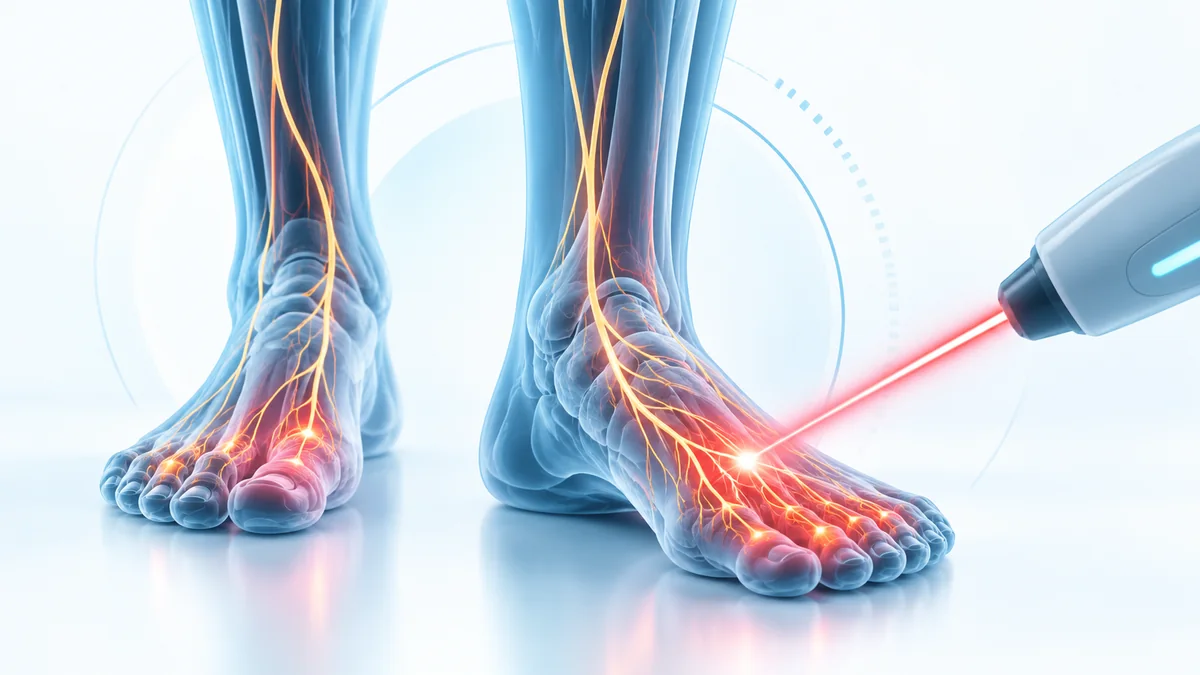
Long-term hyperglycemia can lead to damage in small and large nerve fibers. Symptoms typically include numbness, burning, tingling, and sensory loss starting from the toes and spreading upward. Sensory loss also increases the risk of foot ulcers and unnoticed trauma.
How can laser help?
PBM studies have investigated effects on mitochondrial activity, microcirculation, inflammation, and peripheral nerve function. Although clinical studies report improvements in pain and nerve conduction velocity, this method does not replace diabetes control, neuropathic pain medications, or foot care.
The role of 980 nm
The 980 nm near-infrared wavelength can be used for peripheral nerve and soft tissue targets; however, wavelengths vary across diabetic neuropathy studies. There is no strong comparative evidence specific to 980 nm.
The role of 1470 nm
The strong superficial water absorption and thermal character of 1470 nm require caution, especially in a diabetic foot with sensory loss. There is no direct clinical efficacy data for diabetic neuropathy; numbness can make it difficult to notice thermal damage.
What does the scientific evidence say?
Level of evidence: B-. A 2023 systematic review demonstrated that eight studies reported improvements with PBM in neuropathic pain and certain nerve conduction parameters. However, more recent protocol studies emphasize that the existing evidence is still not sufficiently robust regarding safety and efficacy. Results should not be directly generalized to 980/1470 nm.
In whom can it be considered?
- In those with a clear diagnosis of diabetic peripheral neuropathy
- In those seeking non-invasive pain management in addition to standard treatment
- In selected patients without active ulcers, infection, or severe circulatory impairment
Our approach in our Bodrum clinic
Our approach in our Bodrum clinic is to first evaluate HbA1c/glycemic control, concomitant causes of neuropathy such as B12, foot circulation, sensory loss, and wound risk together. If laser is considered, 980 nm can be addressed as a more rational photobiomodulation option; 1470 nm is evaluated with greater caution regarding thermal safety due to sensory loss. Treatment success is monitored not only by pain scores, but also by sleep, walking tolerance, sensation, and foot safety.
When is a different evaluation required?
In the presence of a new foot ulcer, infection, discoloration, rest pain, loss of pulse, or rapidly progressing loss of strength, vascular, infectious, and neurological evaluation is required first.
Frequently asked questions
Does laser cure diabetic neuropathy?
Current data suggest that there may be improvement in some symptoms; it has not been proven to completely reverse nerve damage.
Is laser safe if there is no feeling in the feet?
Loss of sensation can increase the risk of thermal damage. Caution is required, especially with wavelengths that have a prominent superficial thermal effect, such as 1470 nm.
Can laser be performed before blood sugar control improves?
Glycemic control is the fundamental management of neuropathy; laser does not substitute for it.
References
- PMID 37622461 — PBM in diabetic peripheral neuropathy, systematic review.
- PMID 39186566 — Protocol for systematic review/meta-analysis on PBM in diabetic peripheral neuropathy; discusses the limitations of current evidence.
Information
This content is for general health information; it is not a personalized diagnostic or treatment recommendation.