
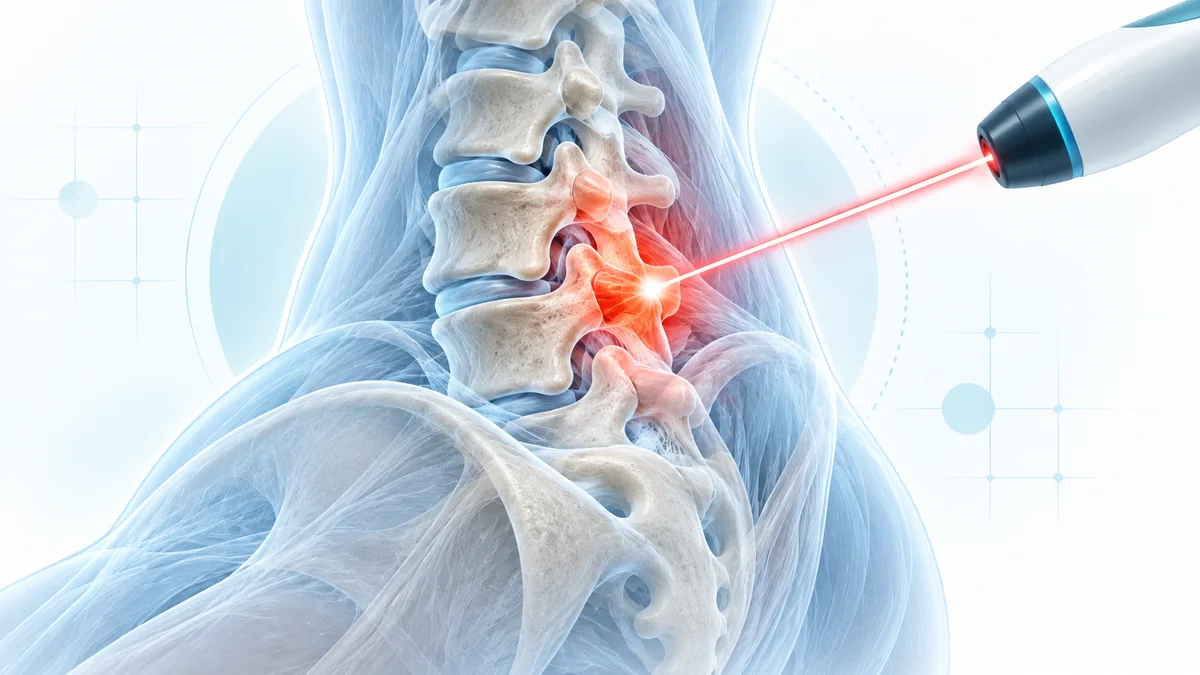
What is facet joint pain?
Facet pain can often increase with backward bending, rotation, or standing for a long time. Pain radiating to the upper buttocks in the lower back and to the shoulder girdle region in the neck can be seen. Diagnosis is made not only by imaging, but through clinical evaluation.
How can laser help?
Although low back and neck pain studies with HILT show pain reduction, most of these studies have not confirmed the source of pain specifically as the facet joint. Therefore, rather than a claim of direct facet treatment, it should be evaluated as symptomatic support for surrounding soft tissues.
The role of 980 nm
In terms of reaching paraspinal muscle and superficial periarticular targets, it is more suitable compared to 1470 nm.
The role of 1470 nm
Because it has a more superficial thermal character, it is not the primary wavelength for deeper targets such as the facet joint.
What does the scientific evidence say?
Level of evidence: C. Evidence for HILT exists for low back and neck pain; however, randomized studies specific to facet syndrome are insufficient.
Our approach at our Bodrum clinic
At our Bodrum clinic, the differentiation of facet, disc, sacroiliac joint, myofascial, and radicular pain is performed first. If laser is to be planned, surrounding soft tissues are targeted; when necessary, imaging and interventional diagnostic-treatment options are also evaluated.
When is a different evaluation required?
If there is new loss of strength, sensory loss, fever, trauma, or changes in urinary or bowel control, the priority is advanced evaluation.
References
- PMID 39652213 — HILT musculoskeletal pain umbrella review.
- PMID 37493840 — HILT in low back pain.
- PMID 38709332 — HILT in neck pain.
Information
This content is general health information.