
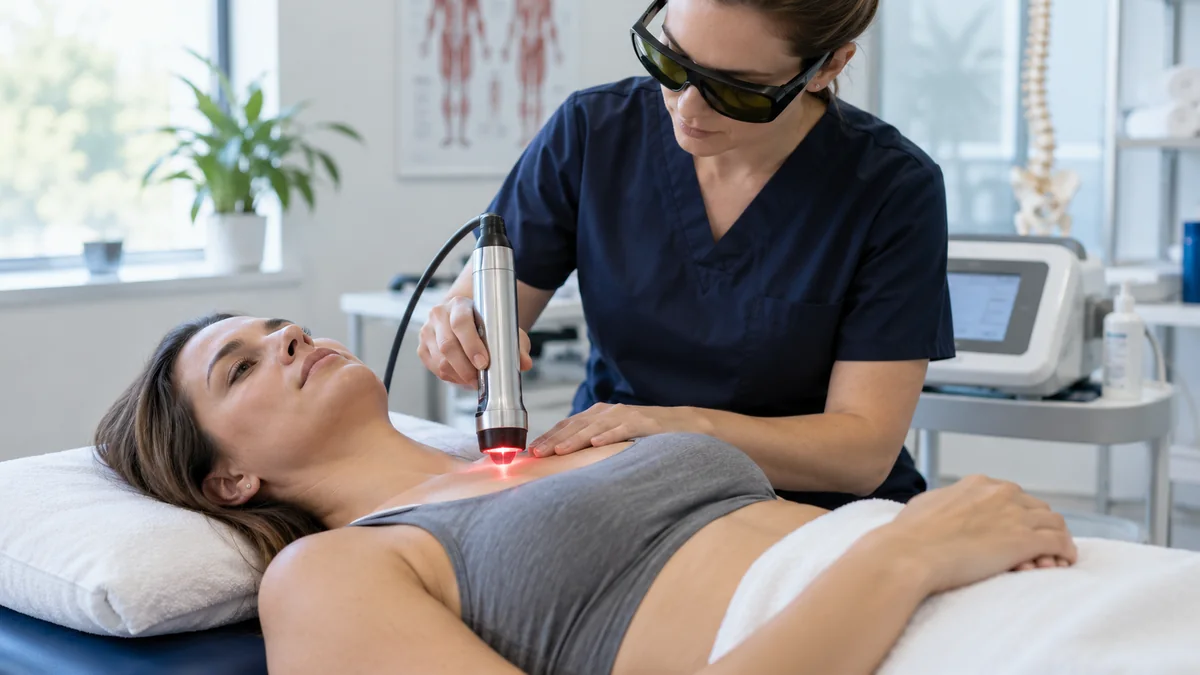
What is costochondritis?
The pain is mostly localized adjacent to the breastbone and can increase with pressure, trunk movement, deep breathing, or coughing. However, because chest pain can originate from very different causes such as the heart, lungs, pleura, reflux, shingles, and trauma, the diagnosis must be made carefully.
How can laser help?
The analgesic and anti-inflammatory effects of photobiomodulation in musculoskeletal pain have been investigated. Because the costochondral area is superficial, application is anatomically feasible; nevertheless, disease-specific clinical efficacy has not been demonstrated.
The role of 980 nm
It is the more rational wavelength for adjunctive pain control in the superficial and medium-depth soft tissues of the chest wall. There are no clinical data specific to costochondritis for 980 nm.
The role of 1470 nm
Because the costosternal area is superficial, 1470 nm delivers strong superficial energy to the tissue; however, this does not mean that efficacy is higher. There is no direct clinical evidence, and the thermal load on the skin/bone must be carefully managed.
What does the scientific evidence say?
Level of evidence: D+. Broad PBM/HILT reviews from the 2025–2026 period report benefits in knee osteoarthritis, fibromyalgia, and certain other musculoskeletal pains; costochondritis is not a verified separate indication within this evidence base. Therefore, general musculoskeletal data should not be transferred as direct evidence of efficacy for costochondritis.
Our approach at our Bodrum clinic
At our Bodrum clinic, we prioritize ruling out cardiac, pulmonary, traumatic, and neuropathic causes first in chest wall pain. If the examination is consistent with a costochondral/myofascial origin, laser is considered only as an adjunctive option supporting symptom control; breathing-trunk movement, mechanical loading, and accompanying muscle tension are addressed separately.
When is emergency evaluation required?
If there is new-onset pressure-like chest pain, shortness of breath, sweating, nausea, radiation to the jaw or arm, fainting, sensation of arrhythmia, fever, or trauma, emergency medical evaluation is required before applying laser under the assumption of costochondritis.
Frequently asked questions
Does costochondritis resolve with laser?
There is insufficient direct clinical evidence to state this. Laser can only be considered for the purpose of adjunctive pain control in selected patients.
Is applying laser to the chest safe?
The application area, dose, and underlying diagnosis are important. Especially in unexplained chest pain, serious causes must be ruled out first.
References
- PMID 40770824 — Photobiomodulation across multiple health outcomes, umbrella review; not specific to costochondritis.
- PMID 41789279 — High- and low-level laser therapy for orthopedic pain, systematic review; not specific to costochondritis.
- PMID 39652213 — HILT for musculoskeletal pain, umbrella review; not specific to the disease.
Disclaimer
This content is general health information; it is not a personal diagnosis or treatment recommendation.