What does this score mean?
The Confidence Index is not the treatment’s success rate; it is an editorial methodology score that indicates to what extent the scientific finding evaluated on this page can be trusted. Study design, risk of bias, sample size, precision, direct applicability, reproducibility, transparency, and clinical relevance are evaluated together.
What did the study investigate?
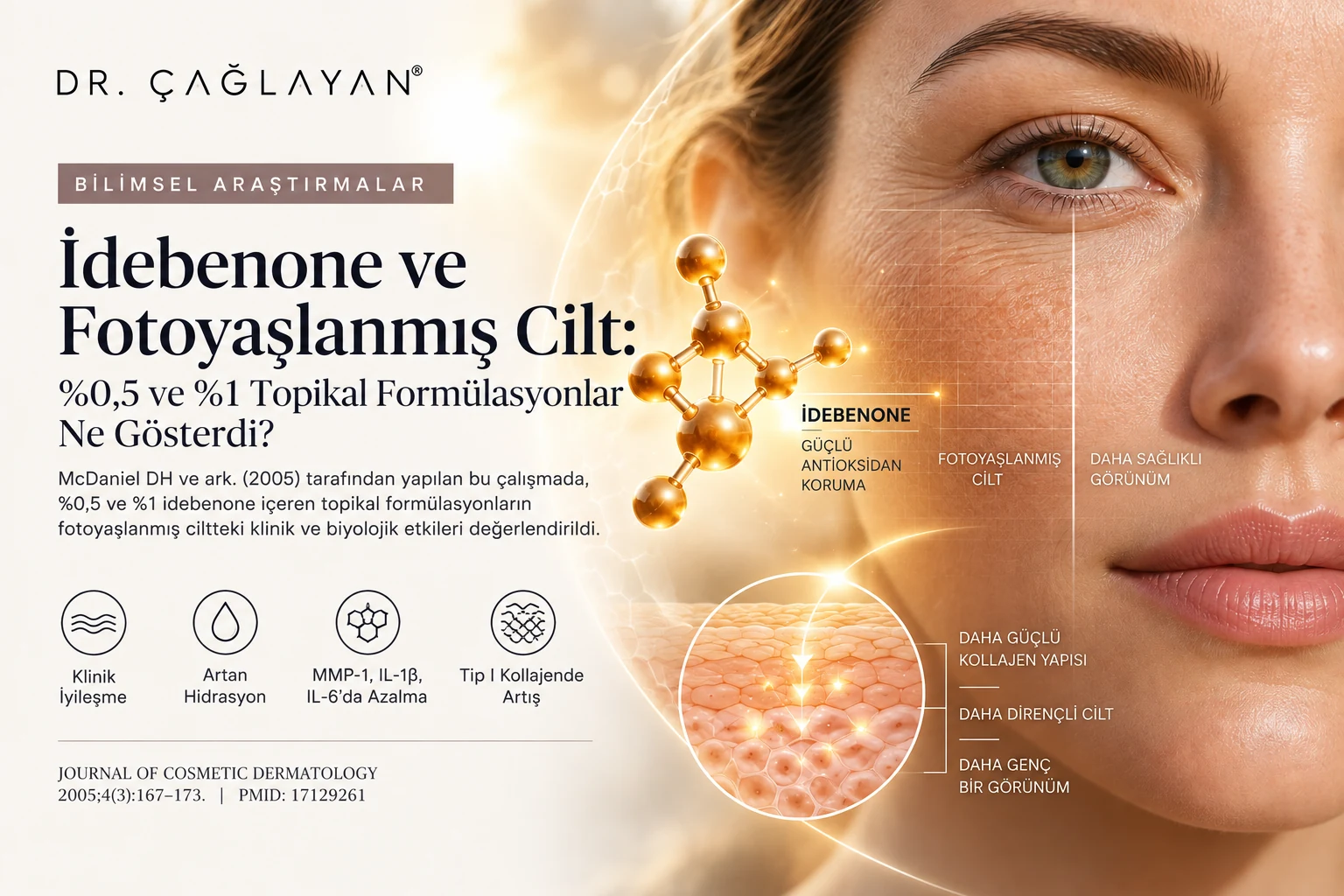
It evaluated the effect of 0.5% and 1% topical idebenone formulations on clinical appearance, hydration, and biological markers in photoaged skin.
How was it conducted?
41 women aged 30–65 used 0.5% or 1% idebenone for six weeks; blinded clinical evaluation, hydration measurement, and selected biopsies were performed.
What was found?
Improvements in hydration, fine line/wrinkle, and photodamage measurements were reported at both concentrations; a decrease in MMP-1 and an increase in Type I collagen were reported in some biomarkers.
Limitations of the study
There is no vehicle control arm without idebenone; the sample size is small, follow-up is short, and there are only female participants. The contribution of the base formulation cannot be distinguished.
What does this mean clinically?
There is a positive human signal for idebenone, but controlled studies are required to confirm the magnitude of the effect and the part specific to idebenone.
What do we not know yet?
Long-term effect, optimal concentration, outcomes across different skin types, and the true level of contribution in vehicle-controlled comparisons are not clear.
Reference
The full citations and links of the sources are preserved in the detailed evaluation section of this page.
Written and medically reviewed by: Dr. Kerem Çağlayan · Information about skin rejuvenation · All Scientific Research
Detailed evaluation
Research evaluation · September 17, 2026
The study by McDaniel et al., published in the Journal of Cosmetic Dermatology, evaluated the clinical and biological effects of topical idebenone on photoaged skin. Idebenone is a lower-molecular-weight synthetic analogue of coenzyme Q10 and has been investigated in cosmetic dermatology for its antioxidant properties.
How was the study conducted?
The study included 41 women aged 30–65 with moderate photodamage. Participants used one of the lotions containing 0.5% or 1% idebenone with identical base formulations in a blind-labeled manner twice daily for a total of 6 weeks.
At baseline, week 3, and week 6, skin roughness/dryness, fine lines/wrinkles, and overall photodamage were examined via blinded expert assessment. Skin hydration was evaluated by electrical conductance measurement. In punch biopsies taken from selected participants, IL-1β, IL-6, MMP-1, and Type I collagen were investigated using the immunofluorescence method.
What results were observed at six weeks?
| Outcome | 0.5% idebenone | 1% idebenone |
|---|---|---|
| Skin roughness/dryness | 23% reduction | 26% reduction |
| Skin hydration | 37% increase | 37% increase |
| Fine line/wrinkle | 27% reduction | 29% reduction |
| Overall photodamage assessment | 30% improvement | 33% improvement |
One of the noteworthy points of the study is that the clinical results between 0.5% and 1% idebenone were quite close to each other. When this study is evaluated on its own, increasing the concentration from 0.5% to 1% was not shown to provide significant additional clinical superiority.
What was observed in biological markers?
In immunofluorescence analyses, a reduction in the expression of IL-1β, IL-6, and MMP-1 and an increase in Type I collagen were reported at both concentrations. MMP-1 is one of the matrix metalloproteinases associated with collagen breakdown. Therefore, the decrease in MMP-1 and the increase in Type I collagen provide a mechanistic signal in terms of photoaging alongside clinical observations.
However, biomarker changes alone do not prove long-term clinical anti-aging efficacy.
What is the most important limitation of the study?
This study is not vehicle-controlled. In other words, there is no separate control group using the same lotion base without idebenone. Therefore, it is not possible to definitively distinguish how much of the improvement, particularly in hydration, dryness, and appearance, stems from idebenone versus the moisturizing effect of the lotion base.
Furthermore, the sample consists of only 41 individuals, the follow-up duration is limited to 6 weeks, and the study includes only female participants. These characteristics limit the generalizability of the results to broader populations and long-term use.
What does this mean from a clinical and cosmetic perspective?
The study suggests that topical idebenone may produce a promising clinical signal in photodamaged skin in terms of hydration, roughness, fine lines, and overall appearance. The reduction in MMP-1 and increase in Type I collagen in the biopsy findings are also biologically interesting.
However, these data are not sufficient to definitively prove that idebenone alone reduces wrinkles by the stated percentages. In particular, vehicle-controlled studies with larger sample sizes and longer follow-up are needed.
Quality of evidence
Limited, hypothesis-supporting human data. The presence of direct clinical evaluation and biopsy data in humans is a strength of the study. Conversely, the small sample size, short follow-up, and absence of a vehicle-control group reduce the strength of causal interpretation.
References
- McDaniel DH, Neudecker BA, DiNardo JC, Lewis JA II, Maibach HI. Clinical efficacy assessment in photodamaged skin of 0.5% and 1.0% idebenone. Journal of Cosmetic Dermatology. 2005;4(3):167–173. doi:10.1111/j.1473-2165.2005.00305.x. PMID: 17129261.
- Wiley – Original study.
This content is an evaluation of scientific literature. It does not replace cosmetic or dermatological treatment recommendations.