What is Morton’s neuroma?
Rather than a true tumor, it is considered a fibrotic thickening of the interdigital nerve due to repetitive compression and irritation. Narrow shoes, high heels, and excessive load on the forefoot can increase complaints.
How can laser help?
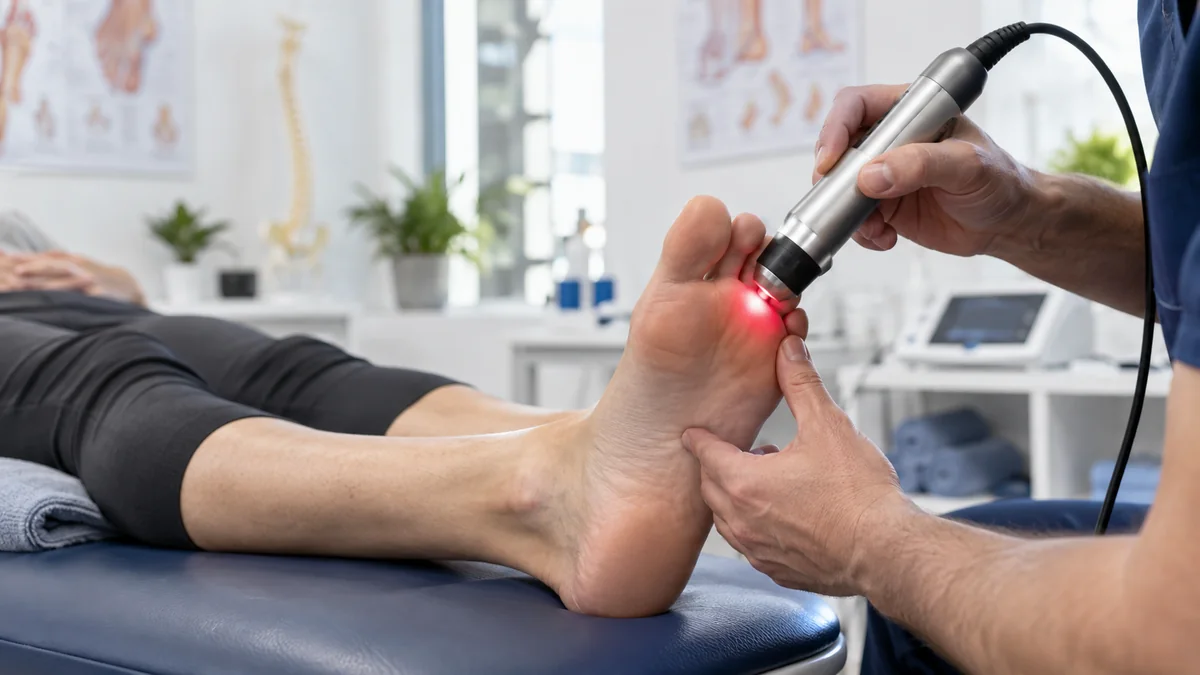
The goal of laser is theoretically to reduce local neuropathic pain and surrounding soft tissue irritation. It has not been proven to eliminate mechanical compression on the nerve or the presence of a distinct fibrotic mass.
The role of 980 nm
The near-infrared wavelength can be considered biophysically for peripheral nerve and soft tissue targets; however, there is no randomized clinical data specific to 980 nm for Morton’s neuroma.
The role of 1470 nm
The superficial thermal effect of 1470 nm requires caution in the sensitive nerve tissue of the forefoot. There is no direct clinical efficacy data for Morton’s neuroma.
What does scientific evidence say?
Level of evidence: D. A 2016 retrospective ultrasound study reported changes in pain and ultrasound findings after laser; because there was no control group, it is not evidence of causal efficacy. A 1064 nm HILT case presentation published in 2026 reported marked improvement in a single patient; a case presentation does not constitute generalizable evidence of efficacy. Laser data is also limited in systematic reviews of non-surgical treatments.
In whom can it be considered?
- In selected patients whose diagnosis has been confirmed clinically and, when necessary, with ultrasound
- If symptoms persist despite modification of footwear and forefoot load
- When an additional noninvasive option is sought with the limited nature of the evidence clearly explained
Our approach at our Bodrum clinic
Our approach at our Bodrum clinic is first to distinguish Morton’s neuroma from metatarsalgia, MTP joint pathologies, stress injury, and peripheral neuropathy, and to modify footwear and forefoot loading. If laser is considered, it is explained to the patient that the available evidence is of low level, and it is not substituted for approaches that correct mechanical compression.
When is a different evaluation required?
In cases of progressive sensory loss, severe night pain, trauma, marked swelling, or inability to bear weight, other causes should be investigated.
Frequently asked questions
Does Morton’s neuroma shrink with laser?
There is insufficient controlled clinical evidence to confirm this. Retrospective ultrasound data is intriguing, but does not constitute a definitive conclusion.
Does it replace surgery?
No. Laser is not a proven equivalent of surgical or injection treatments.
References
- PMID 27897032 — Morton neuroma before/after laser: retrospective ultrasonographic study.
- PMID 31718949 — Non-surgical treatments for Morton’s neuroma, systematic review.
- PMID 41964534 — 1064 nm HILT for Morton’s neuroma: single case report.
- PMID 38334217 — Interventions for Morton’s neuroma; randomized evidence remains limited.
Disclaimer
This content is general health information; it is not a personal diagnosis or treatment recommendation.