What are bruxism and masseter pain?
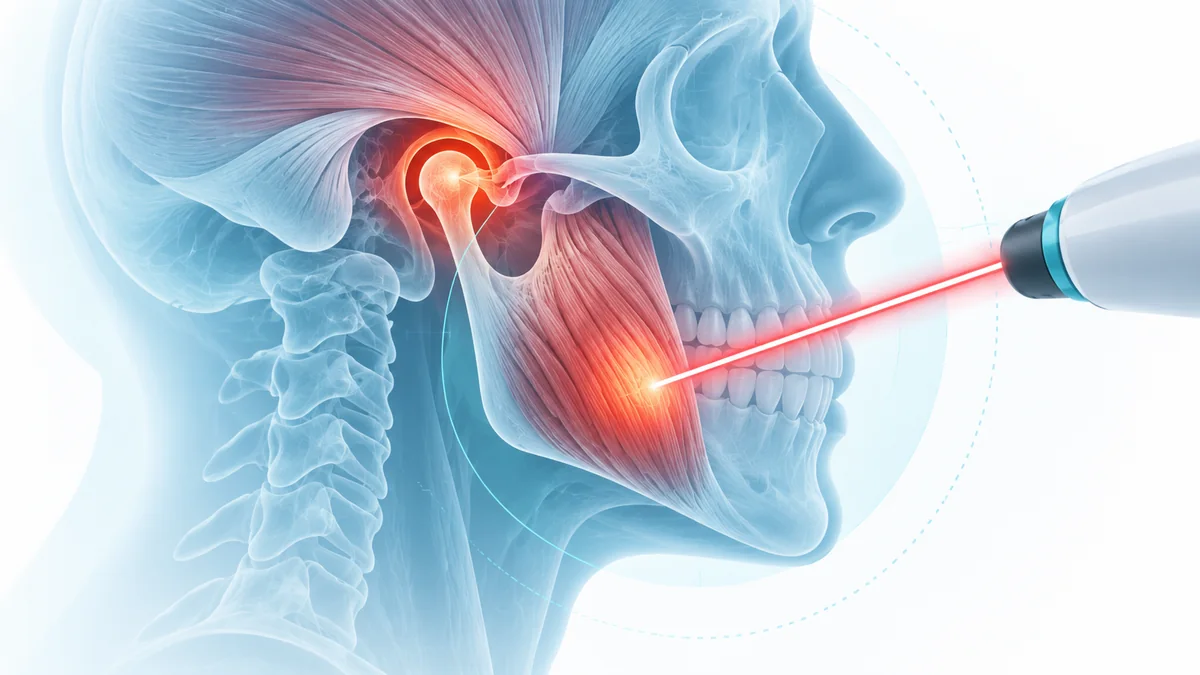
Bruxism is the behavior of clenching or grinding teeth during wakefulness or sleep. Overload in the masseter and temporalis muscles can cause morning jaw fatigue, facial pain, headache, and tenderness during chewing. Bruxism and temporomandibular disorders are not the same thing, but they can occur together.
How can laser help?
The analgesic effect of photobiomodulation and its effects on local circulation and muscle activity have been investigated. Laser does not eliminate the behavioral, sleep-related, or occlusal factors that cause bruxism; it primarily targets the painful muscle component.
The role of 980 nm
There is a direct randomized clinical trial for 980 nm in myofascial masticatory muscle pain. In this study, 980 nm showed better outcomes in pain and mandibular function compared to 635 nm; however, the sample size is small and there is no placebo group.
The role of 1470 nm
There are no direct efficacy studies of 1470 nm in masticatory muscle pain. Due to its more superficial thermal character, it can theoretically be considered for very superficial muscle targets, but it should not be presented as a routine primary wavelength.
What does the scientific evidence say?
Level of evidence: B+. A 2025 systematic review reported that PBM can improve pain and mandibular function in both muscular and articular TMJ disorders. The RCT specific to 980 nm also provides supporting data. However, evidence that it treats bruxism itself must be distinguished from evidence that it reduces masticatory muscle pain.
In whom can it be considered?
- In masseter or temporalis tenderness accompanying teeth clenching
- In morning jaw fatigue and myofascial facial pain
- For pain control in addition to exercise, behavioral awareness, or dental treatment
Other related treatment option
In prominent masseter/temporalis hyperactivity and myofascial pain due to teeth clenching, laser is not the only option for every patient. Depending on clinical evaluation, botulinum toxin in bruxism and masseter pain may also be evaluated in selected patients.
Our approach in our Bodrum clinic
Our approach in our Bodrum clinic is to distinguish whether jaw pain originates from muscle, joint, dental, or neuropathic causes; and if bruxism is present, to address sleep, stress, daytime clenching behavior, and, if necessary, dental evaluation together. If laser is to be chosen, 980 nm has more direct evidence for the myofascial muscle target.
When is a different evaluation required?
In cases of jaw locking, trauma, marked joint swelling, dental infection, changes in facial sensation, or atypical severe facial pain, the underlying cause must first be clarified.
Frequently asked questions
Does laser stop teeth clenching?
No. Laser can help reduce the painful muscle component; it has not been shown to eliminate the bruxism behavior itself.
Is it an alternative to masseter Botox?
It is not a direct equivalent. Their mechanisms of action and indications are different.
Can it also be used for TMJ pain?
PBM has supportive evidence in TMJ disorders; however, a distinction must be made between joint- and muscle-derived pain.
References
- PMID 41039333 — 980 nm versus 635 nm diode laser for myofascial pain, randomized trial.
- PMID 41251874 — PBM in muscular and articular temporomandibular disorders, systematic review.
- PMID 37744015 — Updated systematic review of PBM in TMD.
Information
This content is general health information; it is not personal diagnostic or treatment advice.