What is De Quervain tenosynovitis?
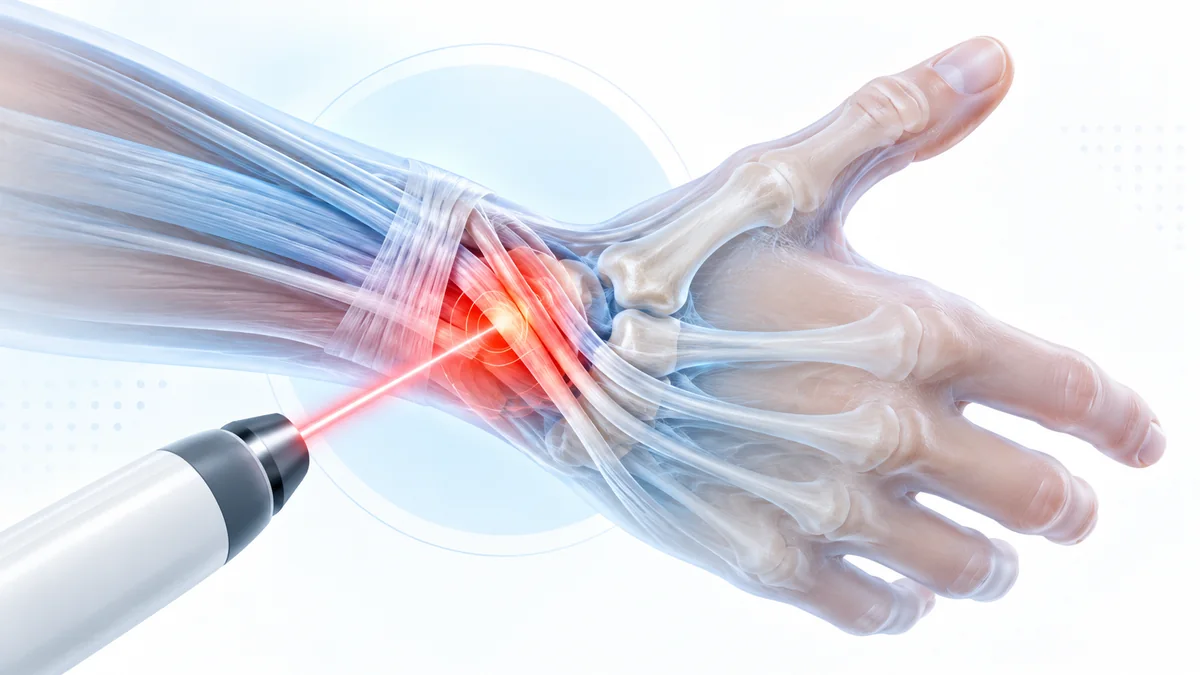
It is a painful tenosynovitis that develops in the first dorsal compartment, through which the abductor pollicis longus and extensor pollicis brevis tendons that move the thumb pass. Phone use, carrying a baby, repetitive gripping, and wrist movements can increase symptoms.
How can laser help?
The goal is to improve pain control and tolerance for daily use. Laser does not directly eliminate mechanical constriction in the tendon sheath. Activity modification, splinting if necessary, and exercise are fundamental components of treatment.
The role of 980 nm
980 nm can be used in superficial tendon structures; however, devices and wavelengths in published HILT studies for De Quervain are heterogeneous. Therefore, no claim of definitive superiority specific to 980 nm should be made.
The role of 1470 nm
Although 1470 nm appears anatomically accessible because the first dorsal compartment is very superficial, there is no clinical efficacy data specific to this wavelength. Due to high superficial absorption, thermal dosing must be performed carefully.
What does the scientific evidence say?
Level of evidence: B-. The 2025 meta-analysis evaluated three clinical trials; although some individual studies reported positive results, the overall analysis could not demonstrate a significant superiority of HILT over conventional treatments in terms of pain or disability. Therefore, the evidence is promising but not definitive.
Who can it be considered for?
- In those with pain on the thumb side of the wrist clinically consistent with De Quervain
- In those requiring pain control in addition to splinting and load modification
- To facilitate daily hand use
Our approach at our Bodrum clinic
Our approach at our Bodrum clinic is to distinguish De Quervain from CMC joint pain, ganglion, scapholunate pathology, and superficial radial nerve irritation; then to evaluate laser as an adjunct option alongside load management, splinting if necessary, and exercise. If laser is to be chosen, 980 nm is based on more established PBM/HILT experience; 1470 nm is considered only selectively for very superficial targets and with consideration for thermal safety.
Frequently asked questions
Does De Quervain resolve completely with laser?
A definitive result cannot be guaranteed. Studies have not demonstrated a clear superiority of laser over standard treatment.
Is a splint necessary?
In many patients, a splint that reduces the thumb-wrist load may be beneficial for a short period; the decision is made based on the examination.
Does it replace an injection?
No. Laser and injection are different treatment options; they are evaluated according to the severity of the disease and clinical response.
References
- PMID 39814632 — Effects of high-intensity laser therapy in De Quervain’s tenosynovitis: systematic review and meta-analysis.
- PMID 39652213 — HILT musculoskeletal pain umbrella review.
Information
This content is for general health information purposes only; it is not a personal diagnosis or treatment recommendation.