What is golfer’s elbow?
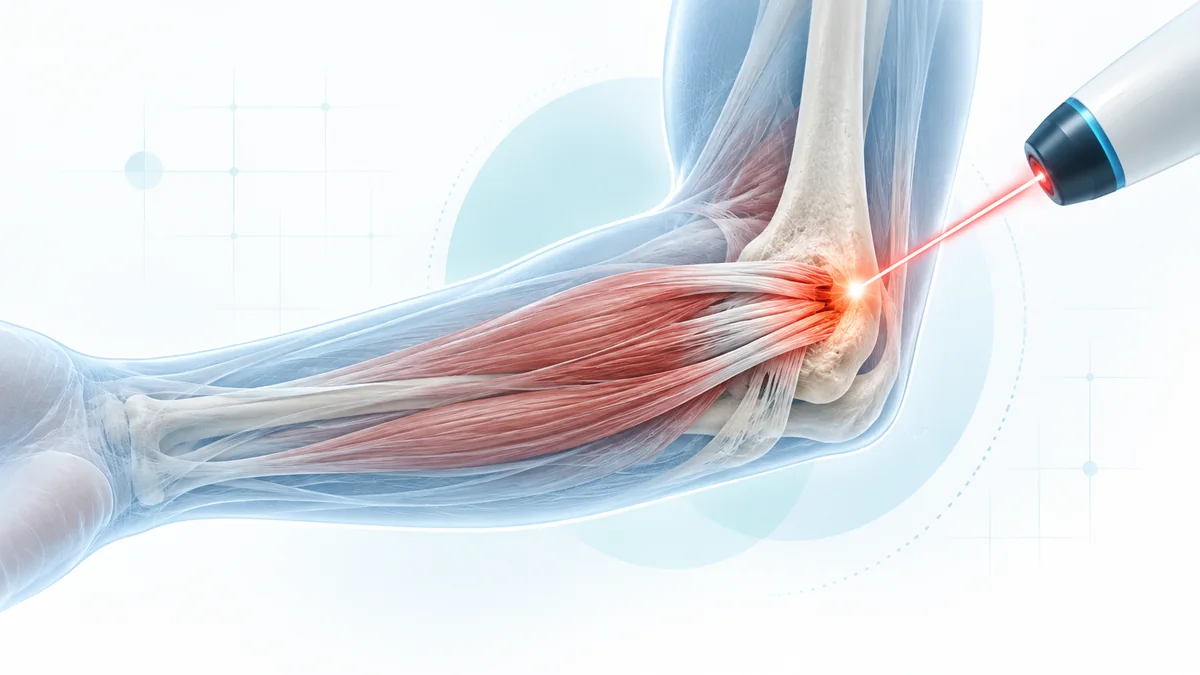
Medial epicondylitis is an overload-related tendinopathy that develops at the attachment site of the wrist flexor-pronator tendons on the inner side of the elbow. In addition to golf, it can also be seen with tennis, racquet sports, weight training, manual labor, and computer use.
How can laser help?
In photobiomodulation studies, reduction of tendon pain, modulation of the local inflammatory response, and improved tolerance to rehabilitation have been investigated. Load management and progressive tendon exercise still form the foundation of treatment.
The role of 980 nm
Direct clinical data for chronic epicondylitis with a 980 nm class IV laser primarily comes from lateral epicondylitis. Although its use in medial epicondylitis is biophysically reasonable due to similar superficial tendon anatomy, a significant portion of the evidence is extrapolated.
The role of 1470 nm
1470 nm is more superficial and thermal in character. It can be used selectively for very superficial tendon targets around the medial epicondyle; however, there are no clinical outcome studies specific to 1470 nm.
What does the scientific evidence say?
Level of evidence: B. Older controlled LLLT data for medial and lateral epicondylitis reported positive results. Most of the current HILT data pertains to lateral epicondylitis, and high-quality data directly for medial epicondylitis is scarce. Therefore, rather than a ‘proven definitive cure,’ it should be presented as an adjunctive option.
Who can it be considered for?
- Those with tendon pain on the inner side of the elbow that increases with loading
- Those experiencing pain with gripping and wrist flexion
- Those who need pain control when initiating exercise
- When ulnar nerve irritation or severe ligament injury has been ruled out
Our approach at our Bodrum clinic
At our Bodrum clinic, in medial elbow pain, we first differentiate between the tendon, ulnar nerve, and ligamentous structures. If laser is considered, 980 nm is the primary option, while 1470 nm is a selective adjunctive wavelength used only for very superficial targets. We combine the treatment with eccentric-concentric tendon loading, grip modification, and sports/occupational ergonomics.
When is a different evaluation needed?
In the presence of numbness in the fingers, marked loss of strength, post-traumatic instability, redness-swelling, or unexplained pain progressing at night, alternative causes must be evaluated first.
Frequently asked questions
Can it also occur in non-golfers?
Yes. The name is misleading; it can be seen in anyone who performs repetitive gripping and wrist flexion.
Is laser alone sufficient?
Generally no. An exercise program that increases the reloading capacity of the tendon is essential.
980 nm or 1470 nm?
In this clinical picture, similar epicondylitis data for 980 nm is more meaningful. Evidence for 1470 nm is not direct.
References
- PMID 9743652 — Medial and lateral epicondylitis with low-level laser therapy.
- PMID 23733499 — Dual wavelength 980/810 nm class IV laser in chronic epicondylitis.
- PMID 39652213 — HILT musculoskeletal pain umbrella review.
Disclaimer
This content is for general health information purposes; it does not substitute for personalized diagnosis and treatment.