What is tennis elbow?
Tennis elbow, or lateral epicondylitis, is a tendinopathy characterized by pain and load sensitivity in the common extensor tendon region on the lateral side of the elbow. It can increase with gripping, using a screwdriver, weightlifting, racquet sports, or repetitive wrist movements. Differential diagnosis is required for radial nerve irritation and intra-articular causes.
How can laser help?
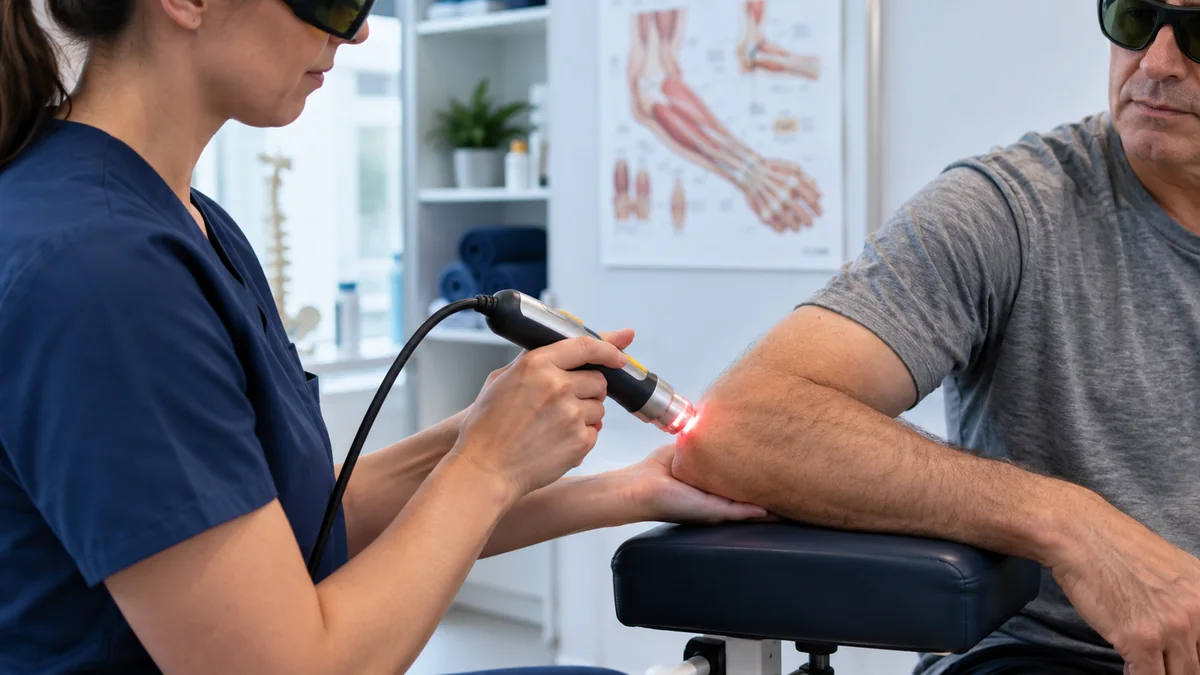
HILT and photobiomodulation have been investigated for pain modulation, local inflammatory response, and peritendinous tissue metabolism. The goal is to reduce pain and facilitate controlled loading of the tendon. Laser alone does not restore the load-bearing capacity of the tendon.
The role of 980 nm
It can be considered the primary wavelength for the tendon and musculotendinous junction. A significant portion of the clinical HILT literature comes from 980 nm or nearby NIR wavelengths.
The role of 1470 nm
Since the lateral epicondyle is quite a superficial target, 1470 nm can theoretically be a selective adjunctive wavelength. However, because its water absorption is high, skin temperature and energy accumulation must be monitored carefully; and the evidence of efficacy should not be considered equivalent to 980 nm.
What does the scientific evidence say?
Level of evidence: A-. Meta-analyses of HILT in tendinopathies report favorable results regarding pain and disability in certain regions, including lateral epicondylitis. Due to protocol differences, claiming definitive superiority is not appropriate.
Is laser sufficient on its own?
In most cases, no. Grip load, wrist extensor strength, isometric/isotonic tendon loading, and occupational-sports ergonomics are adjusted. Success should be monitored by grip strength and function alongside pain.
Our approach at our Bodrum clinic
Our approach at our Bodrum clinic is to distinguish whether lateral elbow pain originates from the tendon, joint, or nerve; to use the 980 nm laser as a method supporting tendon rehabilitation in appropriate patients; and to selectively evaluate 1470 nm for very superficial targets.
When is an alternative evaluation required first?
If there is acute trauma, elbow locking, significant swelling-redness, or widespread neurological deficit, further evaluation is required first.
Frequently asked questions
Is laser effective for tennis elbow?
Studies report improvements in pain and function in some patients. The best outcome is aimed for when laser is used in combination with tendon loading exercises and ergonomics.
980 nm or 1470 nm?
980 nm is the primary option; 1470 nm can be considered an adjunctive wavelength in selected patients due to the superficial target.
References
- Meta-analysis of HILT in tendinopathies
- Current review of musculoskeletal HILT
- 980/1470 nm physics comparison
Information
This content is for general health informational purposes.