What is prepatellar bursitis?
Due to working on the knees for prolonged periods, repetitive pressure, trauma, or infection, the bursa in front of the kneecap can swell and become painful. Commonly, it can be described as swelling in front of the kneecap or pain when putting weight on the knee.
How can laser help?
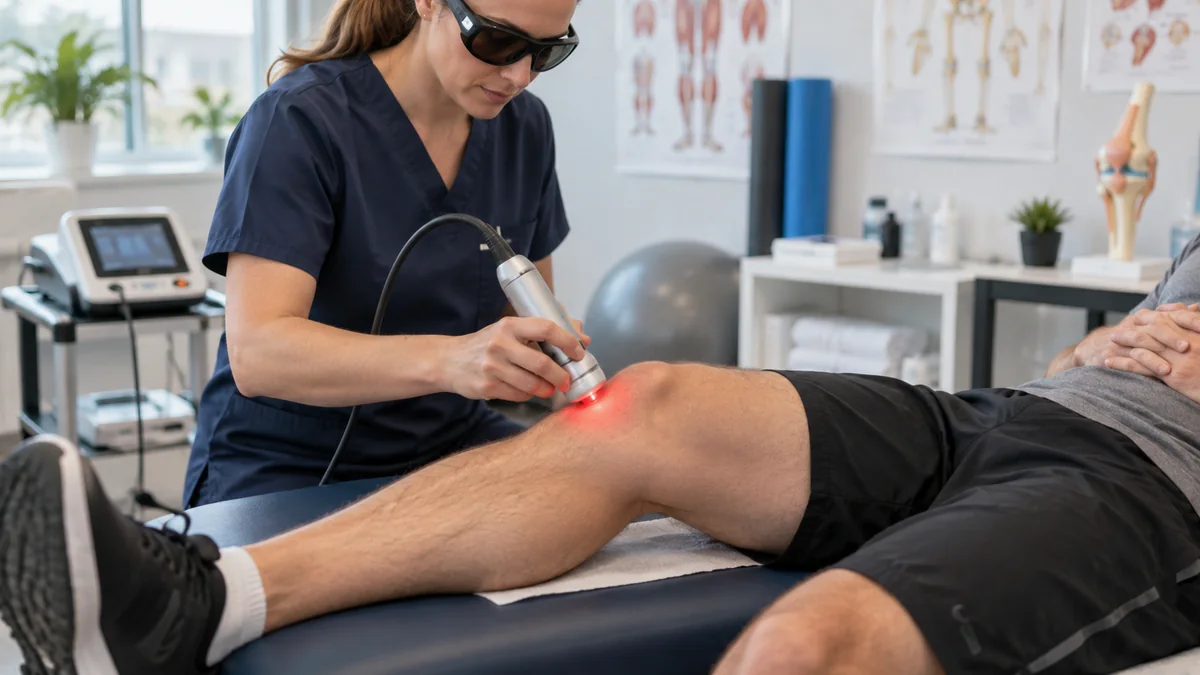
Since disease-specific evidence is limited, the aim is not to claim that it cures bursitis, but to support symptom control in selected non-infectious superficial pain during the recovery period.
The role of 980 nm
It can be used in superficial periarticular tissues; however, there is no evidence of efficacy specific to prepatellar bursitis.
The role of 1470 nm
Although 1470 nm appears anatomically accessible because the bursa is very superficial, careful dosing is required due to high superficial thermal absorption, and there are no disease-specific clinical data.
What does the scientific evidence say?
Level of evidence: D+. The prepatellar bursitis management literature primarily focuses on approaches such as differentiating septic from non-septic, reducing pressure, medical treatment, and aspiration when necessary. There is no direct strong evidence for laser.
Our approach at our Bodrum clinic
At our Bodrum clinic, whether the bursitis is infected, trauma, and a history of continuous knee loading are evaluated first. If redness, a marked increase in temperature, or suspicion of infection is present, treating the underlying cause takes priority over laser. Laser is considered only as an adjunctive option for selected, non-infectious residual superficial pain.
When is a different evaluation needed first?
If there is fever, redness, marked warmth, rapidly increasing swelling, an open wound, or severe trauma, septic bursitis and other causes must be ruled out.
Frequently asked questions
Does swelling in front of the kneecap go down with laser?
There is insufficient direct clinical evidence to support this. The cause of the swelling must be determined first.
Is laser applied if there is an infection?
No; if infection is suspected, the priority is appropriate medical evaluation and treatment.
References
- PMID 24305696 — Prepatellar bursitis: management review.
- PMID 41789279 — Laser therapy for orthopedic pain, systematic review; not disease-specific.
Disclaimer
This content is for general health information purposes; it is not a personal diagnosis or treatment recommendation.