Symptoms
Pain may be observed in the posterosuperior aspect of the heel with footwear pressure, walking uphill, or rising onto the toes. It may coexist with insertional Achilles tendinopathy and Haglund deformity.
980 and 1470 nm
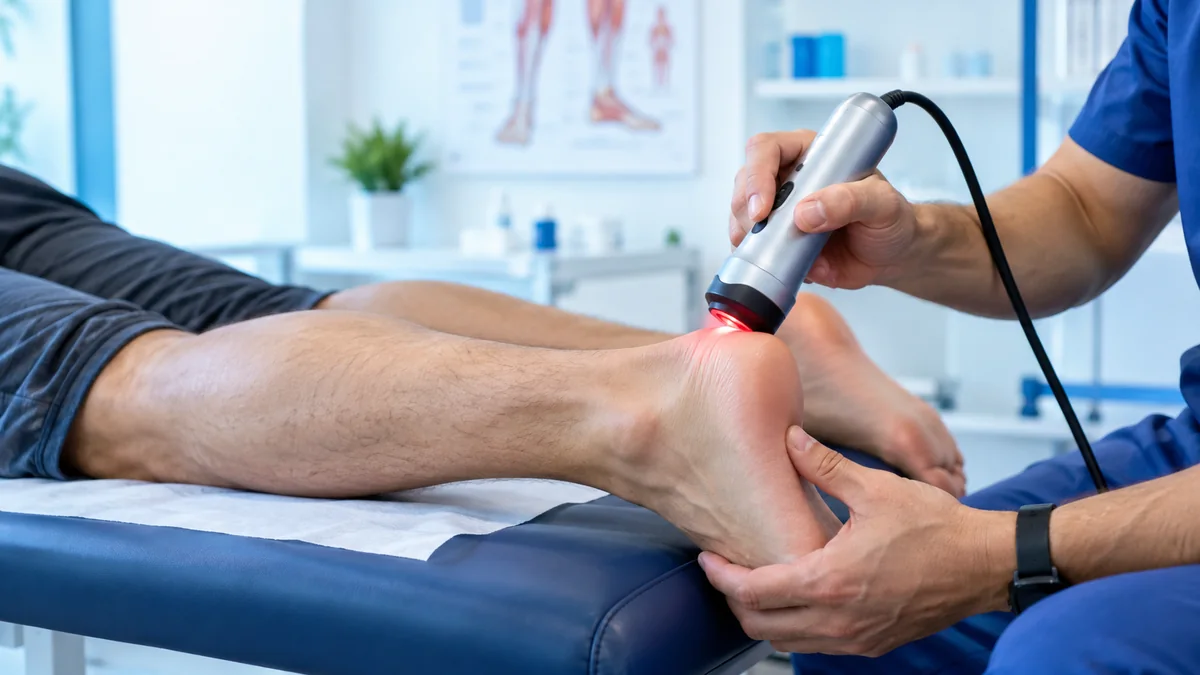
980 nm is a more rational primary wavelength in the tissues around the Achilles-bursa. Because the bursa is superficial, 1470 nm can theoretically be selected; however, there is no direct evidence of efficacy, and the thermal dose requires caution.
Scientific evidence
Level of evidence: C+. There is indirect support from Achilles and tendinopathy data; there are no strong RCT data specific to retrocalcaneal bursitis.
Our approach in our Bodrum clinic
Footwear pressure, Haglund morphology, Achilles insertion, and loading patterns are evaluated together. Laser is not approached alone, but in conjunction with load and footwear modification.
References
- PMID 27330704 — High power laser in Achilles tendinosis.
- PMID 41964853 — HILT tendinopathy meta-analysis.