
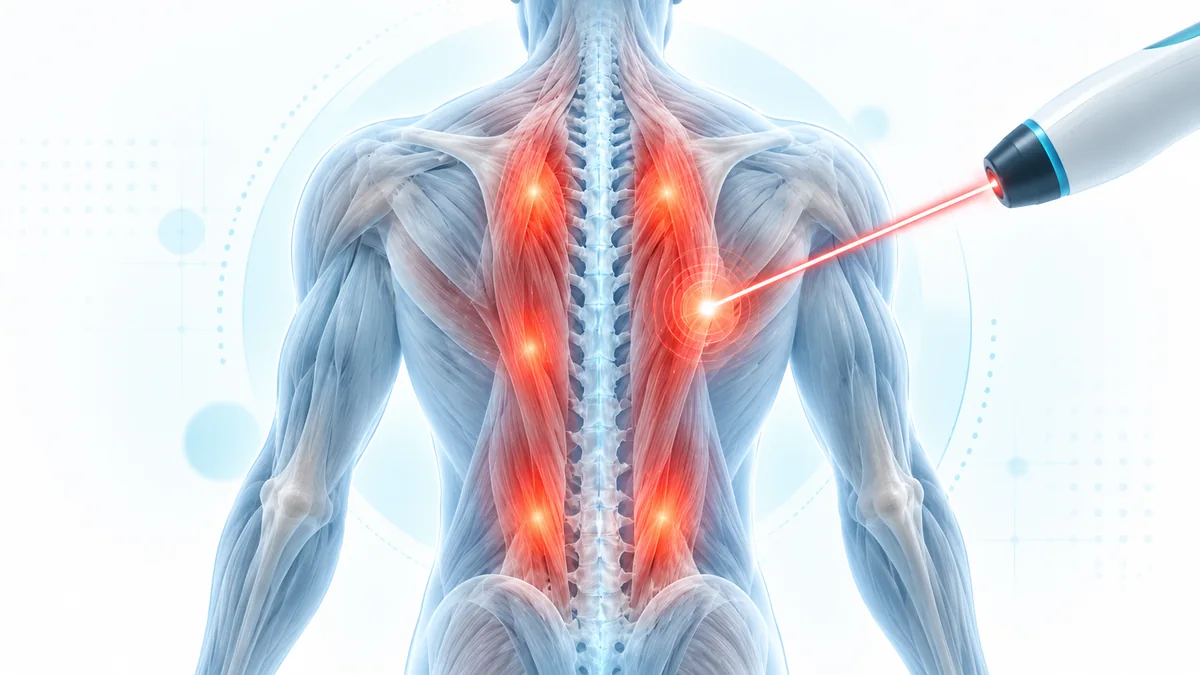
What is paravertebral muscle spasm?
Pain, stiffness, and protective spasm can develop in the erector spinae, multifidus, and surrounding muscles extending along both sides of the spine. Prolonged sitting, sudden loading, exercise, low back- or neck-related pain, or myofascial trigger points may accompany this.
How can laser help?
Analgesic effect and functional improvement have been reported in HILT studies for low back and neck pain and myofascial pain. There is no single uniform standard protocol specific to paravertebral spasm; the application should be considered as an adjunctive treatment targeting painful muscle tissue.
The role of 980 nm
It is the primary wavelength due to better penetration in superficial and mid-depth muscle tissues.
The role of 1470 nm
Since it has a more superficial thermal character, it should only be used selectively in tender bands close to the surface.
What does scientific evidence say?
Evidence level: B. Strong RCT series specific to paravertebral spasm are limited; however, direct HILT data for chronic low back pain, neck pain, and myofascial pain are supportive.
Our approach at our Bodrum clinic
Our approach at our Bodrum clinic is to differentiate whether the spasm is purely muscular in origin or secondary to pain originating from the disc, facet, nerve root, or hip. Laser is planned in conjunction with exercise, mobilization, and load modification.
Frequently asked questions
Does muscle stiffness resolve with laser?
Pain and movement limitation may decrease in some patients; however, it may recur if the underlying cause is not corrected.
How many sessions are required?
It is personalized according to the diagnosis, acute-chronic stage, and response to the initial applications.
References
- PMID 39652213 — HILT musculoskeletal pain umbrella review.
- PMID 38709332 — HILT in neck pain systematic review/meta-analysis.
- PMID 37493840 — HILT in low back pain systematic review/meta-analysis.
Information
This content is general health information.