What is fibromyalgia?
In fibromyalgia, pain does not originate from only a single muscle or joint. Central pain processing mechanisms, sleep, stress response, physical conditioning, and various biological factors play a role together. Therefore, local treatments applied solely to tender points neither explain the entire disease nor treat it on their own.
How can laser help?
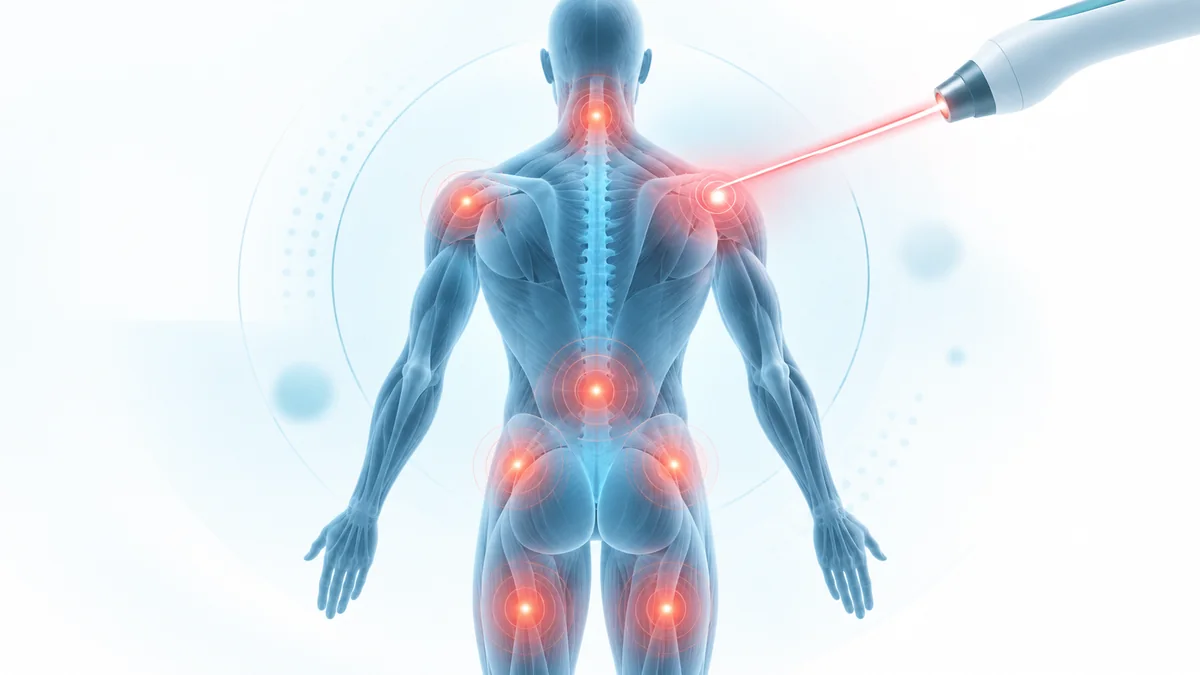
In photobiomodulation and HILT studies, effects on local pain, the number of tender points, quality of life, and exercise tolerance have been investigated. The goal is not to eliminate the widespread pain syndrome with a single device, but to support symptom control in selected painful areas.
The role of 980 nm
980 nm is a clinically rational wavelength for superficial and mid-depth myofascial tender points. However, a significant portion of publications specific to fibromyalgia have been conducted with different wavelengths and devices; robust comparative data specific to 980 nm are limited.
The role of 1470 nm
1470 nm has a more superficial and thermal character. There are no direct clinical efficacy studies for fibromyalgia, and it cannot be recommended as a routine primary wavelength in widespread pain syndrome.
What does the scientific evidence say?
Level of evidence: B. In published meta-analyses for low-level laser, improvements in pain, FIQ, number of tender points, and certain symptoms have been reported; the methodological quality of the studies and protocol heterogeneity are limiting factors. In a 2025 single-blind randomized study, HILT + exercise demonstrated better outcomes in pain, health status, and quality of life compared to exercise alone. These positive findings are promising; however, HILT data at the single-study level should not be directly generalized to 980/1470 nm.
In whom can it be considered?
- In fibromyalgia patients with prominent local myofascial tenderness areas
- In those whose participation in exercise is restricted due to pain
- In those seeking non-invasive symptom control in addition to standard multidisciplinary treatment
Our approach in our Bodrum clinic
Our approach in our Bodrum clinic is not to evaluate fibromyalgia solely through trigger points, but to address sleep, physical activity, conditioning, stress, and accompanying metabolic and neurological factors together. If laser is to be used, 980 nm is considered a more rational option in local tender areas; it is clearly explained to the patient that there is no direct evidence for 1470 nm. Treatment success is monitored through sleep, fatigue, activity, and quality of life in addition to pain.
When is a different evaluation required?
Newly developing muscle weakness, fever, inflammatory joint findings, unexplained weight loss, anemia, or neurological deficit should be evaluated separately without being attributed to fibromyalgia.
Frequently asked questions
Does fibromyalgia go away completely with laser?
No. Laser may help reduce symptoms such as pain and tenderness in some patients; it does not eliminate all biological and central pain mechanisms of fibromyalgia.
Does laser replace exercise?
No. Aerobic activity, strengthening, sleep routine, and personalized pain management are foundational approaches.
Can it be applied to tender points?
It can be applied to selected local tender areas; however, in widespread body pain, it should not be assumed that the entire disease is treated solely with local application.
References
- PMID 40032695 — High-intensity laser therapy in women with fibromyalgia, randomized controlled trial.
- PMID 31151332 — Low-level laser therapy for fibromyalgia, systematic review and meta-analysis.
- PMID 39652213 — HILT musculoskeletal pain umbrella review.
Information
This content is general health information; it is not a personal diagnosis or treatment recommendation.