What does this score mean?
The Confidence Index is not the success rate of the treatment; it is an editorial methodology score showing the extent to which the scientific finding evaluated on this page can be trusted. Study design, risk of bias, sample size, precision, direct applicability, reproducibility, transparency, and clinical relevance are evaluated together.
What did the study investigate?
It investigated whether proteomic age clocks change during rentosertib treatment and to what extent this change can be interpreted in terms of biological aging.
How was it conducted?
Serum samples from 42 participants with completed proteomic data from a 71-person Phase 2a IPF study were re-analyzed using six different proteomic age clocks.
What was found?
In the treatment arms, particularly at week 4, shifts toward a younger estimated biological age were observed in some clocks; the signal was weaker at week 12.
Limitations of the study
The analysis is small, disease-specific, secondary, and based on surrogate endpoints; it is not powered for longevity. Disease improvement cannot be separated from modification of aging biology.
What does it mean clinically?
The study shows that proteomic age clocks can be incorporated into clinical trials; it does not make rentosertib a longevity treatment.
What do we not know yet?
It is not known whether clock changes are associated with healthspan, frailty, lifespan, or functional outcomes, and whether they can be generalized to healthy individuals.
Source
Full citations and links to the sources are retained in the detailed evaluation section of this page.
Written and medically reviewed by: Dr. Kerem Çağlayan · Healthy aging and longevity · All Scientific Research
Detailed evaluation
Research evaluation · September 12, 2026
The study, published in Nature Biotechnology on September 7, 2026, re-evaluated serum proteomics data from a phase 2a study conducted with the TNIK inhibitor rentosertib, developed for idiopathic pulmonary fibrosis (IPF), using six different proteomic age clocks.
How was the study conducted?
The main phase 2a study had randomized 71 IPF patients to rentosertib 30 mg once daily, 30 mg twice daily, 60 mg once daily, or placebo. Among patients who consented to serum proteomic screening, 42 individuals with completed data were included in this analysis. The mean age was 67.1 years, and follow-up lasted 12 weeks.
Researchers used six different proteomic age clocks on serum samples: models focusing on chronological age and models trained on mortality risk were evaluated together. The strength of this approach is that it does not rely on a single “biological age” algorithm; its weakness is that what the clocks measure differs from one another.
What was the main finding?
Across the treatment arms, the overall direction in all six clocks was toward a lower estimated biological age, whereas the change in placebo was more limited. A significant portion of the total comparisons was concentrated particularly at week 4. The broadest clock concordance was observed in the 30 mg twice-daily arm; five of the six clocks signaled in the same direction at week 4 in this arm.
In the 60 mg once-daily arm, the change in biological age compared to placebo at week 4 across four chronological clocks was approximately in the range of −2.7 to −3.5 years. Larger numerical changes were also observed in organ-specific mortality clocks; however, these are exploratory analyses and should not be interpreted as “the organ genuinely rejuvenated by this many years.”
Why did the signal weaken at week 12?
Compared to week 4, the number of statistically significant clock comparisons decreased at week 12. Rather than a simple “loss of effect,” the authors discuss this in terms of the possibility of a plateau. While certain treatment effects on protein levels persisted through week 12, the aggregate output of the clocks may not have changed to the same extent.
Why is the mechanism intriguing?
Rentosertib can affect fibrotic TGF-β networks, extracellular matrix remodeling, inflammation, and cellular stress pathways via TNIK inhibition. In the study, significant changes were detected in the trajectory of 326 proteins over time. Alongside a decrease in certain proteins associated with fibrosis and ECM, changes were also observed in protein networks related to metabolism, stress response, and senescence.
However, the fundamental problem here is this: improvement in IPF can also shift proteomic clocks in a “younger” direction. In this study, it is not possible to completely distinguish disease improvement from the true modification of aging biology.
Does this study mean “AI drug reversed age”?
No. The fact that artificial intelligence-based drug discovery methods were used in the development of rentosertib and that age clocks changed is noteworthy; however, clinical longevity endpoints such as mortality, lifespan, frailty, physical performance, cognitive decline, or healthspan were not tested in the study.
Proteomic age clocks are valuable research tools, but they remain surrogate markers. A clock decreasing by a few years does not mean that the same amount of biological age has been reversed.
Safety and limitations
- The proteomic analysis includes only 42 individuals.
- All participants were IPF patients; results cannot be generalized to a healthy longevity population.
- Follow-up was only 12 weeks.
- The analysis was not powered for clinical longevity endpoints.
- The study’s authors include researchers affiliated with the developing company.
- Renal/hepatic limits, pregnancy safety, and long-term risk profile have not been defined for longevity purposes.
Impact on practice
Should be monitored; should not be included in protocols. The study is a methodologically important example demonstrating that aging biomarkers can be incorporated into disease-focused clinical trials. Rentosertib, however, is still in the investigational stage, and these data do not turn it into an off-label longevity agent.
Quality of evidence
Low. Although samples obtained from a randomized trial were used, the longevity interpretation stems from a small, disease-specific secondary analysis with surrogate endpoints.
Reference
Zhavoronkov A, Galkin F, Chen S, et al. Integration of proteomic aging clocks in a phase 2a clinical trial supports simultaneous geroprotective assessment. Nature Biotechnology. 2026.
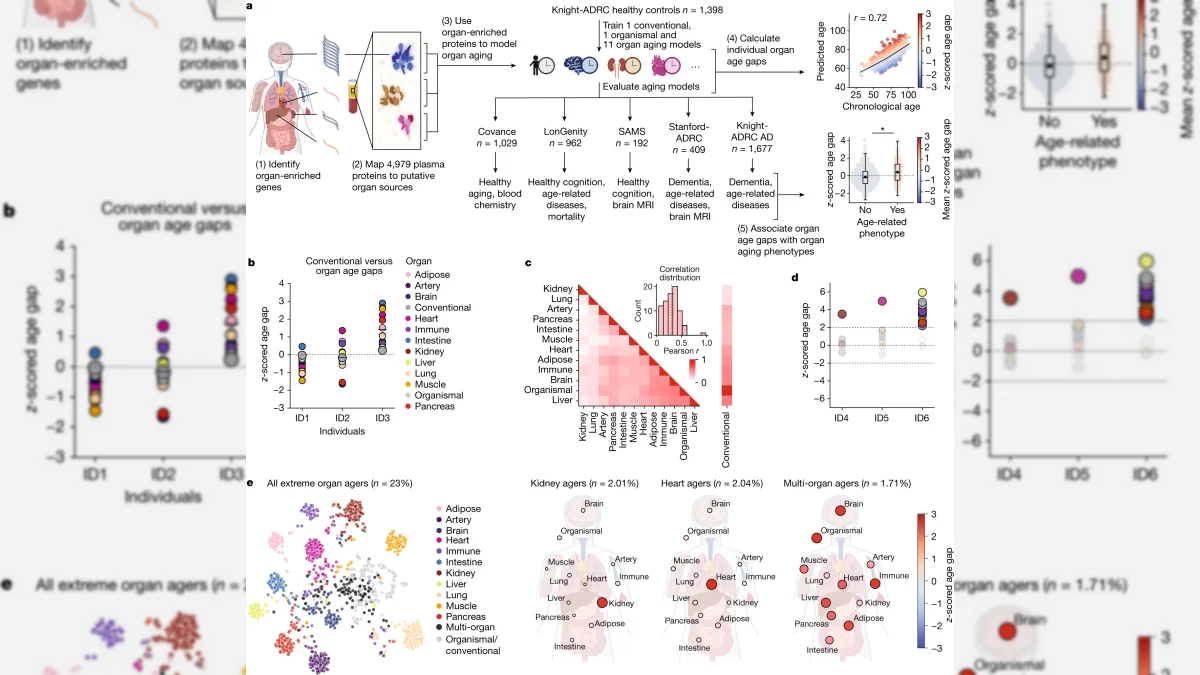
Image: “Plasma proteins can model organ aging” image representing proteomic age clocks, authors of the respective study/Wikimedia Commons, CC BY 4.0. The image is not an original figure from the rentosertib study.