SCIENTIFIC CONFIDENCE INDEX — 65/100
Early clinical evidence; comparative superiority uncertain
Brief conclusion: Histotripsy is a noninvasive ablation method that mechanically destroys liver tumors without heating by creating controlled cavitation with focused ultrasound. Local control results are promising; survival superiority over standard treatments has not yet been proven.
What did it investigate?
Feasibility, safety, and local tumor control in primary and metastatic liver tumors.
How does it work?
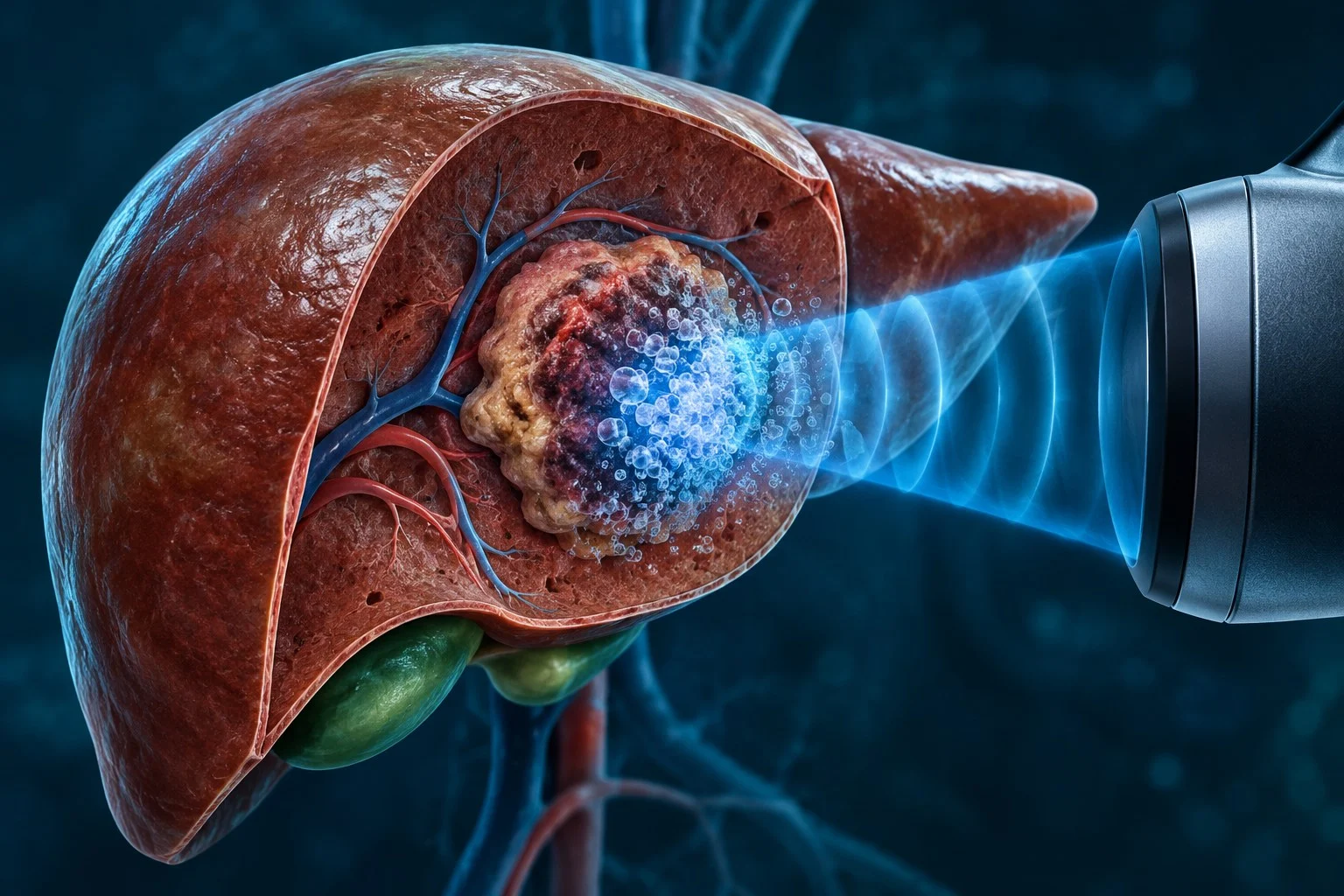
Short, high-pressure ultrasound pulses create a bubble cloud in the target tissue. The dynamics of the bubbles mechanically destroy the cells. It differs from conventional thermal HIFU.
How was it studied?
The multicenter, single-arm HOPE4LIVER trial evaluated 52 tumors in 47 patients. Subsequently, systematic reviews pooling clinical series were published.
What was found?
The one-year local control outcome of HOPE4LIVER varied significantly depending on imaging reassessment. In a 2026 meta-analysis of 553 patients, the pooled technical success was approximately 94.1%, and the major complication rate was approximately 7%. Technical success does not mean a permanent cure from cancer.
Limitations
Most studies are non-randomized. Long-term recurrence and overall survival data are insufficient. The acoustic window, rib and bowel gas, tumor visibility, and operator experience limit targeting. Bleeding, thrombosis, and organ dysfunction may occur.
Immunological potential
Tumor antigen release and T-cell response are being investigated in preclinical studies. The abscopal effect and survival benefit of immunotherapy combination have not yet been demonstrated in humans.
Clinical significance
It may be considered in selected liver lesions through multidisciplinary tumor board evaluation; it is not a universal alternative to surgery, transplantation, thermal ablation, and systemic therapy.
What don’t we know?
Superiority in randomized comparisons, long-term outcomes, and the optimal immunotherapy combination remain uncertain.
Practice in Turkey
Our separate article on access and clinical conditions in Turkey.
References
HOPE4LIVER (2025); Systematic review (2026); FDA De Novo (2023).
The confidence index is an editorial evidence assessment, not a success rate. This content is not a personal treatment recommendation.