What does this score mean?
The Confidence Index does not reflect the success rate of the treatment, but rather the editorial confidence in the clinical conclusion that can be drawn from the available data. Study design, sample size, peer-reviewed publication status, direct clinical comparisons, and safety data were evaluated together.
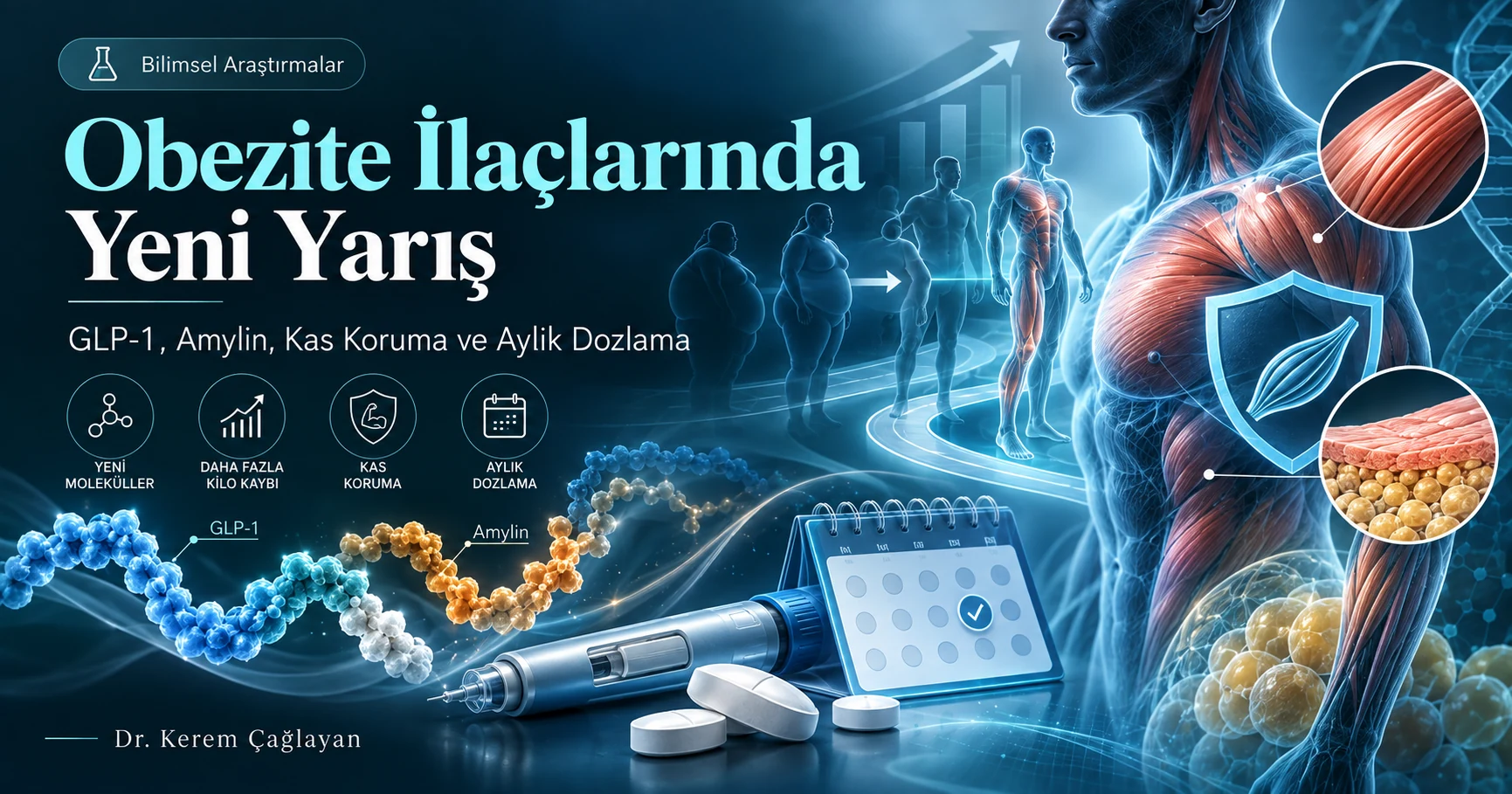
Brief conclusion: Next-generation obesity medications are competing across four axes: greater weight loss, preservation of muscle/lean mass, improved tolerability, and less frequent or oral dosing. Directly ranking percentages from different studies to determine “which drug is better” is scientifically unsound.
Why are targets shifting in obesity treatment?
Semaglutide and tirzepatide have redefined expectations in the pharmacological treatment of obesity. As of 2026, the new race is not merely about increasing total weight loss, but rather focused on adding amylin signaling, reducing muscle loss, developing tablet therapies, and decreasing injection frequency.
The amylin axis: Amycretin and CagriSema
Novo Nordisk’s amycretin, which is also being developed under the name zenagamtide, combines GLP-1 and amylin receptor agonism in a single molecule. In a phase 2 program involving 448 individuals with type 2 diabetes, the weekly subcutaneous form achieved a maximum mean weight loss of approximately 14.5%–14.6% at 36 weeks.
CagriSema, on the other hand, is a fixed-dose combination of the amylin analogue cagrilintide and semaglutide. In REDEFINE 1, the reported mean weight loss for on-treatment participants was 22.7% at 68 weeks. However, in REDEFINE 4, CagriSema failed to meet its prespecified non-inferiority endpoint against tirzepatide 15 mg. For this reason, taking a single percentage out of context is misleading.
Lilly: EloraTZP and retatrutide
EloraTZP combines eloralintide with tirzepatide, targeting the amylin + GIP/GLP-1 axis within the same treatment. In phase 2b, the highest combination dose reported a 23.3% mean weight loss at 48 weeks in individuals with type 2 diabetes. Retatrutide, meanwhile, represents a triple-agonist approach targeting GIP, GLP-1, and glucagon receptors.
Muscle preservation as a distinct new goal
Phase 2 signals indicating that lean mass loss can be reduced by adding agents targeting the myostatin pathway, such as trevogrumab, to semaglutide demonstrate that the industry is turning toward the question “how much of the weight lost is fat, and how much is muscle?” in addition to “how much weight was lost?”
Less frequent dosing: PF’3944
Pfizer’s ultra-long-acting GLP-1 receptor agonist PF-08653944 (PF’3944 / MET-097i) is evaluating a transition to a monthly maintenance dose following weekly titration. In interim phase 2b results from VESPER-3, placebo-adjusted mean weight loss reached up to 12.3% at week 28, and weight loss was reported to be sustained after switching to monthly dosing.
Why cannot different studies be directly compared?
Populations, presence of diabetes, baseline BMI, treatment duration, estimand approaches, adherence, and how missing data are handled vary across studies. For instance, in populations with type 2 diabetes, mean weight loss is frequently lower. Therefore, rankings such as “23.3% is better than 22.7%” are not valid unless conducted in a head-to-head comparison within the same protocol.
What will determine the future from a clinical perspective?
The winner of the next generation will likely not be solely the drug that delivers the greatest weight loss. Muscle preservation, gastrointestinal tolerability, cardiovascular outcomes, treatment persistence, dosing frequency, cost, and long-term safety will collectively be decisive.
References
Reuters, September 30, 2026. Weight-loss drug developers line up as competition heats up.
Novo Nordisk, June 6, 2026. Zenagamtide (amycretin) phase 2 T2D data.
Novo Nordisk Annual Report 2025. REDEFINE 1 CagriSema results.
Pfizer, February 3, 2026. PF’3944 VESPER-3 phase 2b results.
Medical evaluation: This content has been prepared for the purpose of evaluating scientific research; it is not personal diagnostic or treatment advice. Investigational drugs should not be interpreted as approved treatments. · All Scientific Research